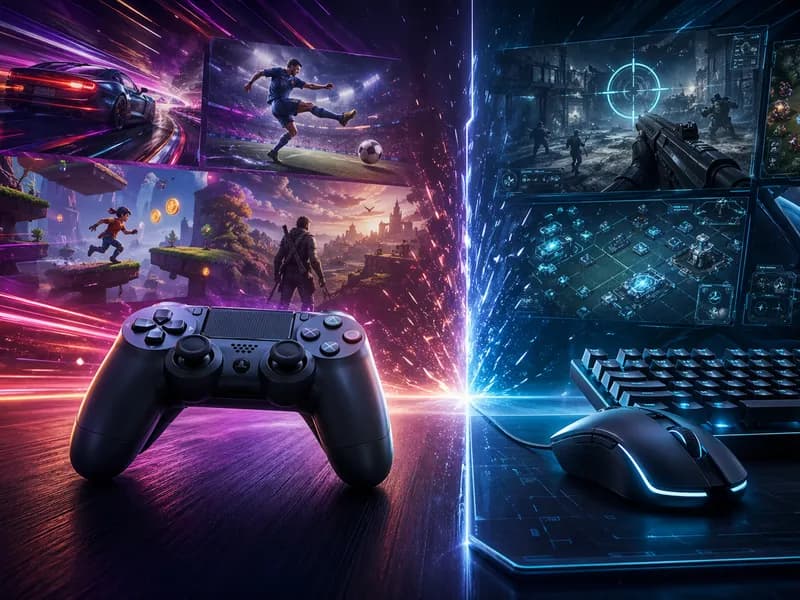
Gamepad or Mouse and Keyboard: Which Is Better for Each Genre
The debate over whether a gamepad or a mouse-and-keyboard setup is better for gaming has been around almost as long as modern multiplayer itself. Some players argue that the mouse is unbeatable because of its precision, while others say a gamepad feels more natural, more comfortable, and better suited for most games. The problem is that this question is often asked as if there were one answer for everything.
In practice, there is no universal winner. Different genres demand different kinds of control, and what feels perfect for a shooter is often not ideal for football, racing, or third-person action adventures. Even more importantly, the choice is not only about reaction speed, but also about camera movement, aiming style, movement control, number of commands, and how much a game actually benefits from analog input.
That is why the more useful question is not “which is better,” but “which is better for what kind of game.” That is where the difference becomes much clearer.
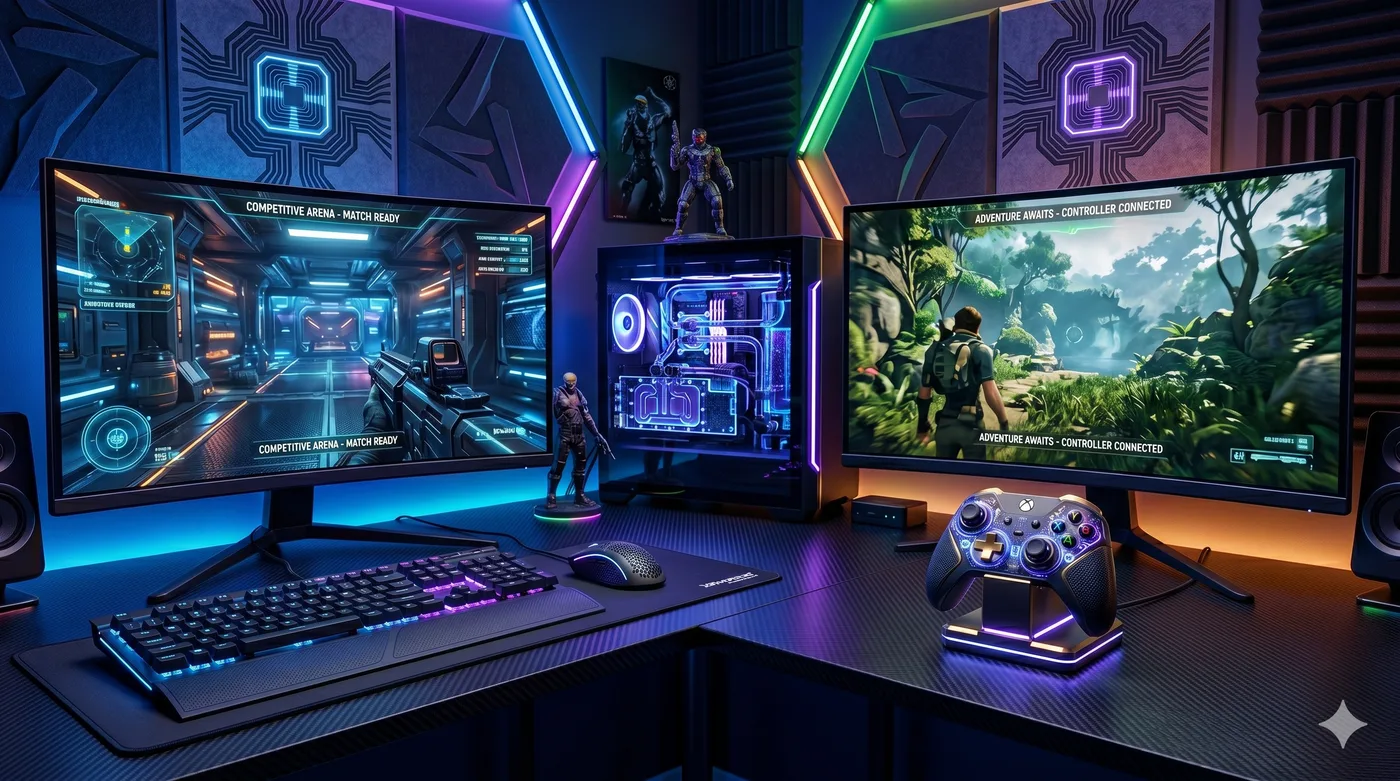
Visual illustration: InfoHelm
Mouse and keyboard dominate where precision matters most
When a game demands fast aiming, precise camera movement, and instant reactions in multiple directions, mouse and keyboard usually have the advantage. This is most obvious in competitive FPS titles, tactical shooters, and many strategy games that were historically designed around PC controls.
The reason is simple. A mouse allows extremely precise and fast aiming without the limitations of analog sticks. When you need to hit a small target, change direction instantly, or control fine adjustments, the mouse is still the most direct tool. The keyboard, meanwhile, gives quick access to a large number of commands, which is especially important in games with inventory systems, hotkeys, abilities, and more complex interfaces.
That is why mouse and keyboard remain the natural choice for competitive shooters, real-time strategy games, MOBAs, and titles where interface control is almost as important as the action itself.
A gamepad is often better when movement and feel matter more than raw precision
On the other hand, a gamepad stands out in games where analog movement matters more than maximum aiming precision. This is especially true in racing games, sports titles, platformers, fighting games, and many third-person action-adventure games.
Analog sticks and triggers allow much finer control of movement. In racing, for example, it makes a difference whether you turn sharply or gently correct your direction. The same applies to games where a character walks, runs, sneaks, or performs actions that benefit from gradual input rather than simple on-off movement. A gamepad feels more natural there because it allows more nuance.
On top of that, many modern action games and console-oriented titles are designed with a controller in mind. The interface, button layout, combat rhythm, and movement feel are often shaped around that style of control.
For shooters, the answer depends on what matters most to you
FPS and TPS games are probably the most interesting example because this argument never really ends. If we focus on pure precision, mouse and keyboard clearly have the advantage. That is especially true in high-level competitive play, fast duels, and situations where a single flick or pixel-perfect adjustment can decide the outcome.
But that does not mean a gamepad is automatically a bad choice. Many players prefer the comfort, hand position, and overall feel of playing with a controller, especially in campaigns, casual multiplayer, or games that are not built around esports-level precision. Game design matters here too. Some shooters include aim assistance that makes controller play much more comfortable than it would otherwise be.
That is why shooters are not just a technical question, but also a contextual one. For serious competitive aiming, mouse and keyboard still make more sense. For relaxed play from a couch or on a larger screen, many players simply prefer a gamepad.
Strategy, simulation, and management games almost always favor mouse and keyboard
As soon as a game requires a lot of menus, multi-unit selection, map interaction, interface management, and constant clicking through many options, mouse and keyboard become the obvious choice. This includes real-time strategy games, city builders, management sims, grand strategy titles, and many more complex simulation games.
A gamepad can work through well-designed menus and radial controls, but that is often still a compromise. When you have to quickly select multiple elements, manage an economy, position units, and rely on shortcuts, mouse and keyboard feel faster, clearer, and more natural.
That is why in these genres the question is almost settled from the start. A gamepad can be acceptable for casual play or ported versions, but mouse and keyboard remain the standard.
Sports, racing, and action games usually feel better on a gamepad
In sports games and racing titles, the situation is often the opposite. A gamepad usually feels more natural than a keyboard precisely because it allows gradual input and smoother control. In football, basketball, or driving, it is not just about triggering a command, but about controlling direction, intensity, and rhythm with more finesse.
The same goes for many third-person action adventures, soulslike games, and open-world titles. In those games, movement rhythm, positioning, combat flow, and the overall feel of controlling the character are often more important than ultra-precise pixel aiming. That is why a gamepad frequently feels more comfortable and intuitive there, even if it is not technically the most precise input method.
This is also why many PC players who normally use mouse and keyboard still reach for a gamepad without hesitation when launching certain genres.
Comfort is an underrated factor, and often matters more than stats
When people talk about controls, they often focus only on performance. In reality, the gaming experience also depends heavily on how comfortable a particular setup feels over a longer session. It makes a difference whether you are sitting at a desk, playing from a couch, using a monitor or a TV, and whether you are gaming for 30 minutes or for three hours.
A gamepad has a major advantage in more relaxed, lean-back gaming. Mouse and keyboard, on the other hand, often feel better for focused desk play, where your body is already positioned for precision and quick reactions.
That is why the best choice is not always the one that is theoretically strongest, but the one that gives you the best mix of control, comfort, and feel in your actual setup.
So which one is better?
The shortest honest answer is: it depends on the genre and on how you play.
If you mostly play competitive shooters, strategy games, MOBAs, and titles with complex interfaces, mouse and keyboard have a clear advantage. If you prefer sports games, racing, platformers, action adventures, and playing from a more relaxed distance, a gamepad is often the more enjoyable and sensible choice.
For many players, the best option is not choosing one side forever, but using both depending on the game. That is also the most realistic answer to a debate that has been framed for years as if there had to be only one winner.
Conclusion
The “gamepad or mouse and keyboard” debate has lasted so long precisely because both sides have strong arguments, just for different situations. Mouse and keyboard offer greater precision, faster access to commands, and better control in more complex interfaces. A gamepad brings comfort, analog movement, and a better fit for many genres that were built with console-style play in mind.
That is why the smartest answer is not to declare one setup better forever, but to recognize what most players eventually discover on their own: the best control method is the one that best fits the specific game.
Note: This article is educational and informational.