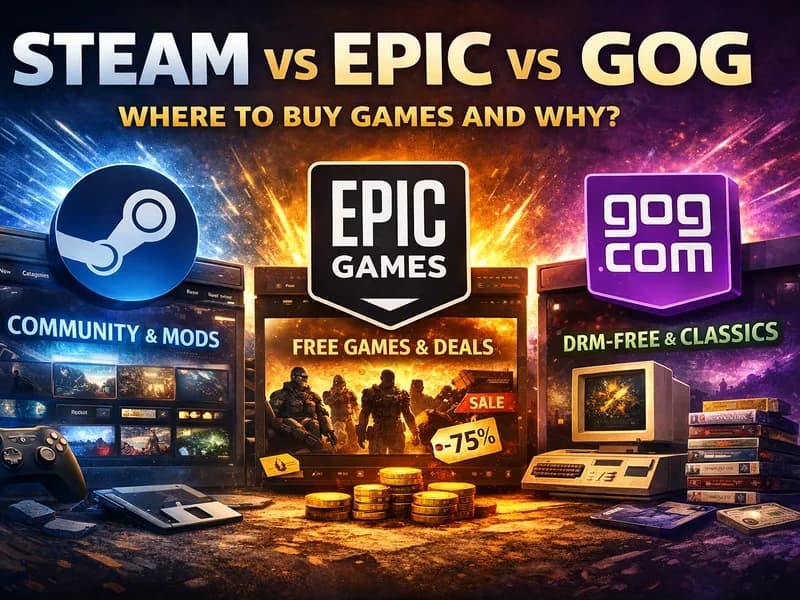
Steam vs Epic vs GOG: where to buy games and why
At first glance, Steam, Epic Games Store, and GOG all seem to do the same thing: they sell PC games in digital form. But once you look a little closer, it becomes clear that the differences are not just about price. They also affect the buying experience, what you actually get with a purchase, and how much control you have over your own library.
For some players, the most important question is where a game is cheapest. For others, the deciding factor is a strong refund policy, an active community, easy mod support, or the feeling that they truly bought a game instead of merely receiving access through a launcher. That is why choosing a storefront is no longer a minor detail, especially for people who build their digital collections over many years.
Visual illustration: InfoHelm
Steam: the safest choice for most PC players
If someone wants one platform that does almost everything well enough, Steam is still the easiest recommendation. Its strength is not only its huge library, but also the ecosystem it has built around the act of buying games: community hubs, workshop support for mods in certain titles, discussions, user reviews, wishlists, and deep integration with the broader PC gaming ecosystem.
Steam Workshop remains one of its biggest practical advantages. In supported games, mods can be found, installed, and updated much more easily than through manual file management, which is a major benefit for players who like to extend a game’s life through community content.
Another point in Steam’s favor is its refund system. For most users, that means additional confidence when buying a game, especially when they are not fully sure how well it will run on their hardware or whether they will actually enjoy it.
For most players, Steam is still the best all-around option when they want a combination of stability, features, community, and the least amount of friction in everyday use.
Epic Games Store: best for free games and deal hunting
Epic Games Store has a different identity. For many users, its greatest practical strength is not the community layer, but its value-focused approach: regular free games, aggressive promotions, and sometimes very competitive prices.
Epic’s storefront also feels simpler and lighter than Steam’s broader ecosystem. Some players prefer that, especially if they do not care much about forums, workshop sections, or deeper community layers.
In practice, Epic is often excellent as a secondary or parallel storefront: ideal for collecting free games, tracking sales, and buying a title when the deal is better than on Steam.
But for players who care most about a rich ecosystem around their library, it still more often remains a complementary option rather than the one main platform.
GOG: best for DRM-free access and a stronger sense of ownership
GOG is playing a different game altogether. Its biggest distinction is not only its catalog, but also its philosophy. The platform has long stood out because of its DRM-free approach, and that directly changes how many players think about buying games.
For players who dislike the feeling that a purchased game remains tied to permanent platform control, GOG offers something that Steam and Epic usually do not place front and center: a stronger sense of control over installation files and long-term access. It also puts special emphasis on older PC classics and game preservation on modern systems.
Another major strength of GOG is its refund policy, which feels more generous than what PC players are used to on most other storefronts. Because of that, GOG often feels closest to the idea of a “real purchase” in the digital world.
GOG GALAXY also tries to solve the problem of scattered libraries by letting users connect multiple platforms and view their games in one place, even if that still does not fully erase the differences between the stores themselves.
Refunds, DRM, and the question of what you are actually buying
This is where the comparison becomes most interesting. With Steam and Epic, the biggest focus is convenience, broad selection, and service ecosystem. With GOG, the focus is much more on giving you a DRM-free copy of the game and a greater level of control over how it is used, stored, and preserved.
If your top priority is buying where the interface feels best, the community is most active, and mod support is easiest, Steam is the strongest candidate. If you want to build a serious library of free titles over time and catch strong promotions, Epic makes perfect sense. If your highest priority is ownership, offline access, and digital preservation, GOG stands out the most.
In other words, the question is no longer only “Where is this game cheaper today?” but also “What kind of digital collection are you building?” For many players, the best answer will not be only one platform, but a mix of all three, each with its own role.
Conclusion
Steam, Epic, and GOG are not just three places to buy games. They represent three different philosophies of digital distribution. Steam dominates in ecosystem and community features, Epic is the most aggressive in free games and value offers, while GOG appeals most strongly to players who want a DRM-free library and a longer-term sense of control over the titles they buy.
That is why the best choice depends less on which store is “objectively the best” and more on what kind of player you are. Some people care most about community, some about discounts, and some about preservation and freedom of use. Once that is clear, choosing between Steam, Epic, and GOG becomes much easier.
Note: This article is educational and informational.