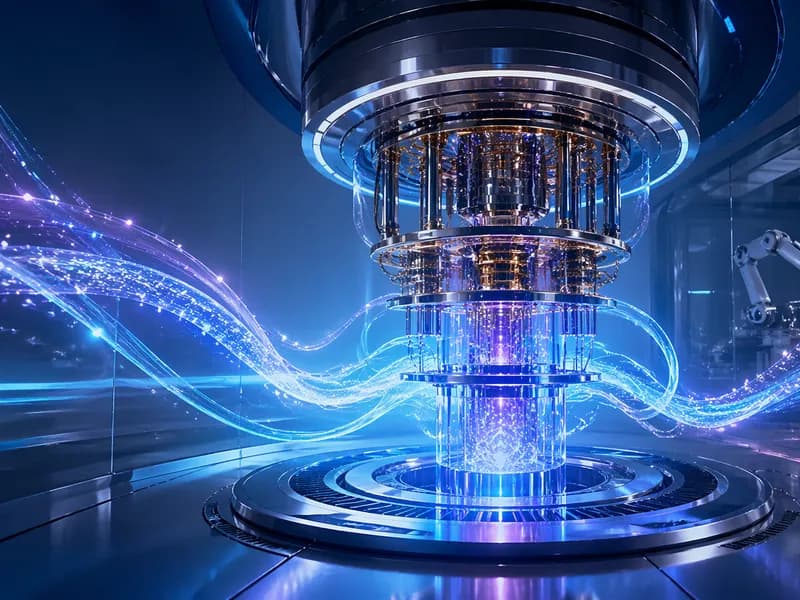
Quantum Computers Enter a New Phase: From Promise to Real Breakthroughs
For years, quantum computing has been one of those technologies surrounded by enormous expectations, but with very little visible impact for the broader public. The conversation often revolved around future revolutions in chemistry, medicine, materials science, and cybersecurity, without a clear answer to when that future would actually begin.
Now the picture is slowly changing. Over the past year, several important advances have emerged from different directions: progress in error correction, more stable logical qubits, new specialized algorithms, and more serious roadmaps from major companies aiming to build useful quantum systems. This does not mean a quantum laptop is about to appear on the average desk, but it does mean the field has entered a new phase — one where it is no longer enough to say something is “quantum.” It now has to demonstrate measurable results.
For readers, that is an important shift. Instead of following a vague story about “the computers of the future,” we can now look at concrete technical progress and assess which approaches have the best chance of moving from the lab into real industrial systems.
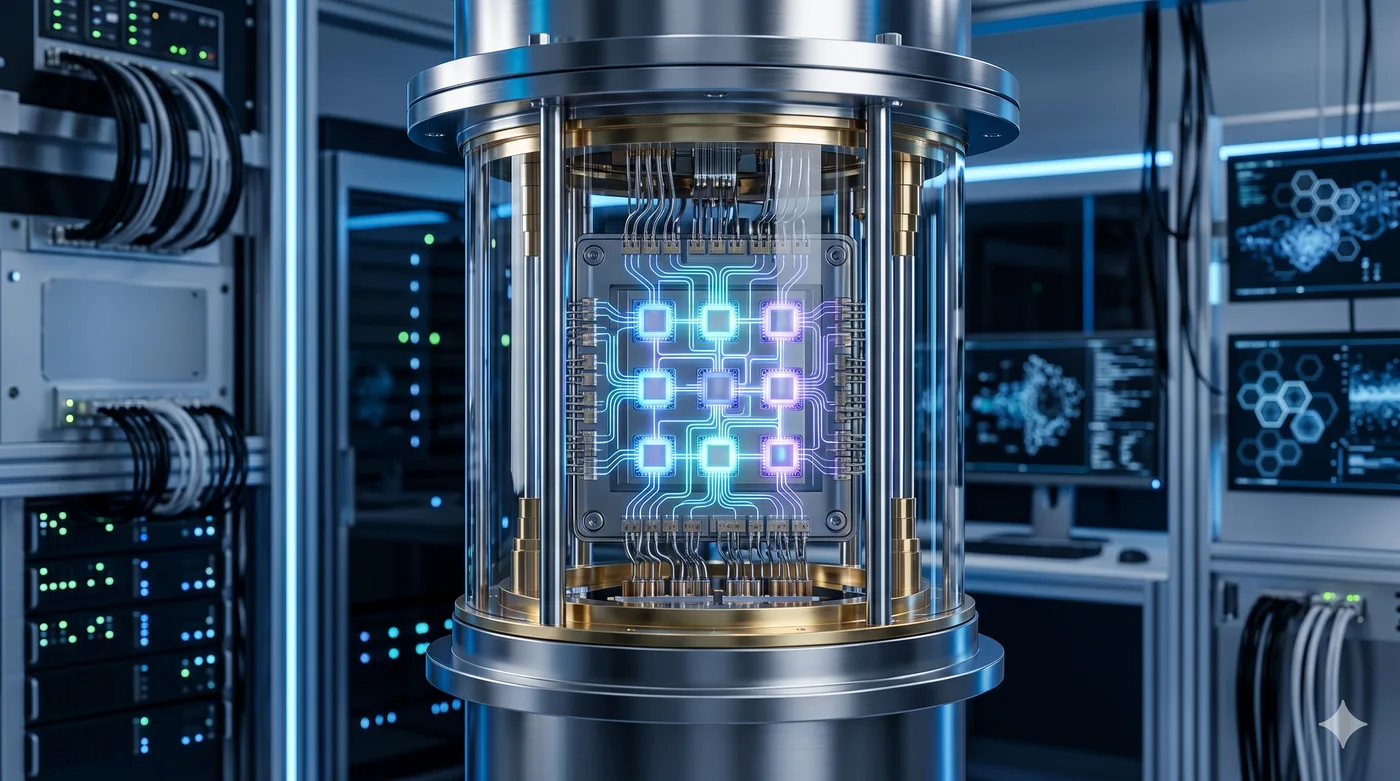
Visual illustration: InfoHelm
The main challenge is no longer just the number of qubits
For a long time, progress in quantum computing was measured mainly by the number of qubits. That sounded impressive in headlines, but in practice it was not enough. Quantum systems are extremely sensitive to noise, interference, and errors, so a large number of physical qubits means very little if the results are unstable or collapse before a computation can finish.
That is why the focus in recent years has shifted from simply increasing qubit counts to something much more important: how to turn fragile physical qubits into reliable logical qubits. This is where error correction comes in, and it has long been considered the biggest barrier standing between today’s prototypes and truly useful quantum machines.
In practice, a logical qubit is not a single physical element, but a carefully organized structure in which multiple physical qubits work together to preserve one unit of quantum information. The idea is not to make every individual qubit perfect, but to make the overall system robust enough to detect and correct errors before they destroy the computation.
That may sound like a technical detail, but it is actually the dividing line between a demonstration and a usable technology. If a quantum computer cannot operate long enough and reliably enough, its theoretical power remains just that — theoretical.
Why 2025 and 2026 are increasingly seen as a turning point
At this stage, there is no single winning approach. Google, IBM, Quantinuum, Microsoft, and others are pushing different architectures, different stabilization methods, and different development strategies. Still, the common thread is clear: the focus is shifting more toward reliability and less toward raw headline-friendly numbers.
That is an important sign of maturity for the entire field. When the real story is no longer just how many qubits a system has, but how long it can preserve quantum information, how effectively it corrects errors, and whether it can produce results that classical systems struggle to reproduce, the technology starts moving into a far more serious phase.
In other words, the industry is no longer trying only to prove that a quantum computer can exist. It is now trying to prove that it can be useful.
What the latest breakthroughs actually mean
One of the most interesting directions is what researchers call verifiable quantum advantage. This means a quantum system is not just doing something exotic, but solving a specific problem in a way that is measurably better than a classical approach, while still allowing the result to be checked. That kind of progress matters because it pushes the field from impressive demos toward meaningful experiments with possible practical consequences.
At the same time, error correction has become the central theme. Instead of waiting for a “perfect qubit,” researchers are building systems that assume imperfection and try to control it through smarter architecture. That is probably a more realistic and healthier path toward useful quantum computing.
It is also increasingly clear that quantum progress will not happen separately from classical computing. On the contrary, more attention is being given to hybrid systems in which classical hardware and software help the quantum layer monitor and correct errors in real time. That means the future of quantum computing is unlikely to be a replacement for classical machines, but rather a collaboration between two paradigms.
Where the first real impact may appear
When practical applications are discussed, the same areas keep coming up: chemistry, materials science, optimization, and cryptography. The reason is straightforward. These are fields where quantum systems may hold a real advantage because they naturally model processes that are themselves quantum in nature.
The most realistic scenario is not that quantum computers will soon replace existing servers, but that they will become specialized accelerators for certain classes of problems. In much the same way that GPUs did not replace CPUs but became essential for graphics, AI, and scientific simulation, quantum processors could become powerful companions for narrow but extremely valuable tasks.
That is probably the most balanced way to understand the current moment. Quantum computers are not about to become everyday consumer devices, but they are no longer just distant theoretical machines either. They are starting to look like a technology searching for its first truly useful niches.
Conclusion
The most important breakthrough in quantum technology may not be one spectacular machine, but a change in the logic of development itself. The focus is shifting from grand promises to stability, error correction, logical qubits, and verifiable results. It is a slower path, but probably the only one that leads to truly useful systems.
That is what makes 2026 such an interesting year for this field. Not because the quantum revolution has already arrived, but because for the first time, the big words are increasingly being matched by concrete technical foundations.
Note: This article is educational and informational.