Quasars: cosmic beacons powered by supermassive black holes
If there’s an object that seems to bend the rules, it’s a quasar. Through a telescope it can look like a point-like “star,” yet it’s actually the blazing core of a distant galaxy—often outshining hundreds of billions of stars combined. And the light comes from a region smaller than our solar system.
That’s why quasars are more than a spectacle. They’re a major tool in modern astronomy and a direct window into the early universe.
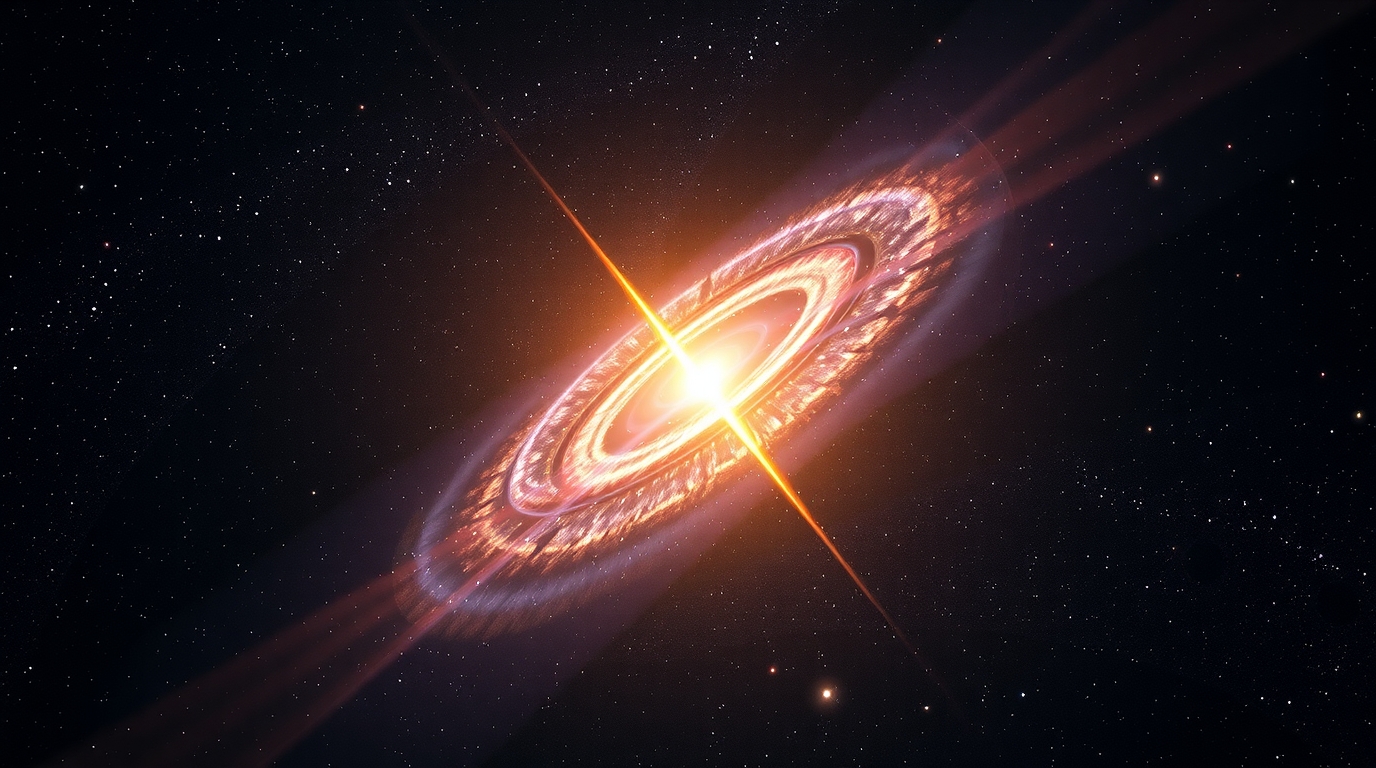
Visual illustration: InfoHelm
What a quasar is
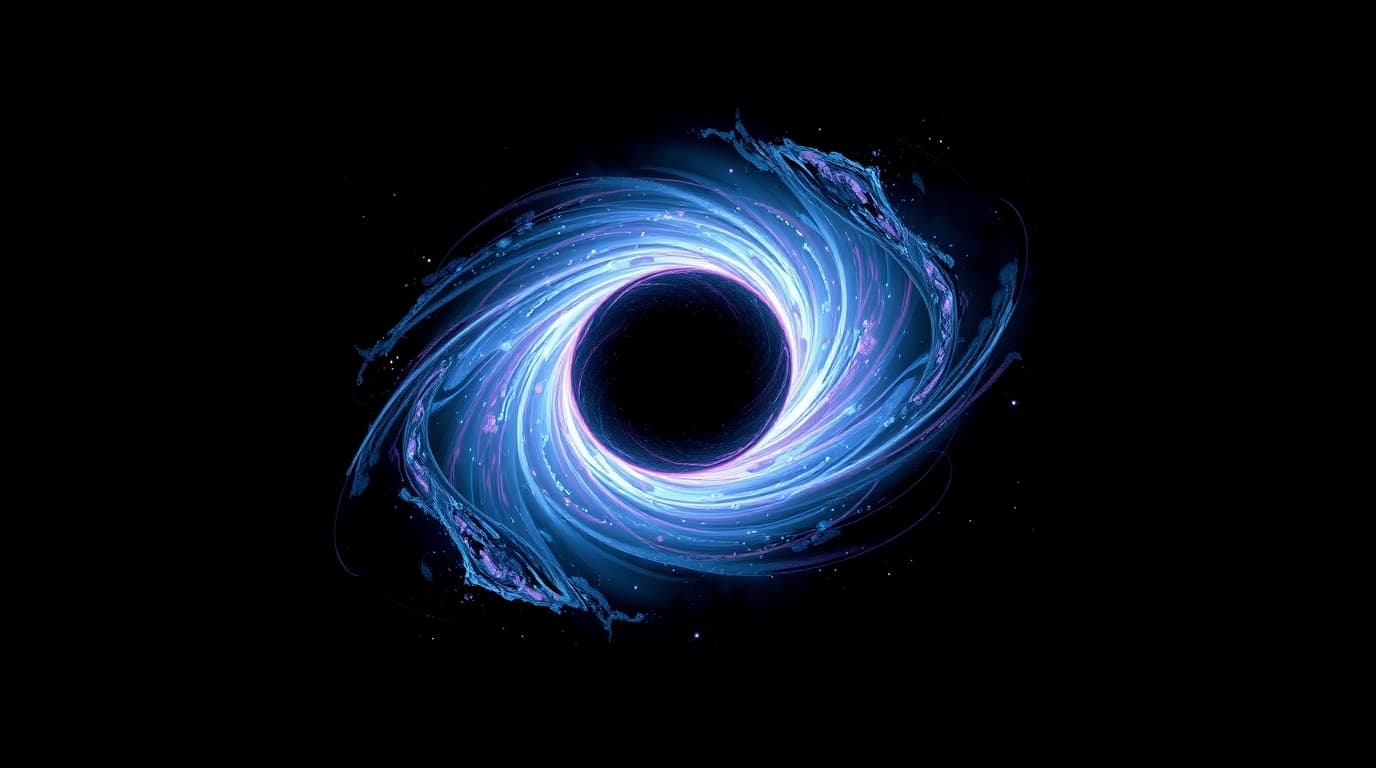
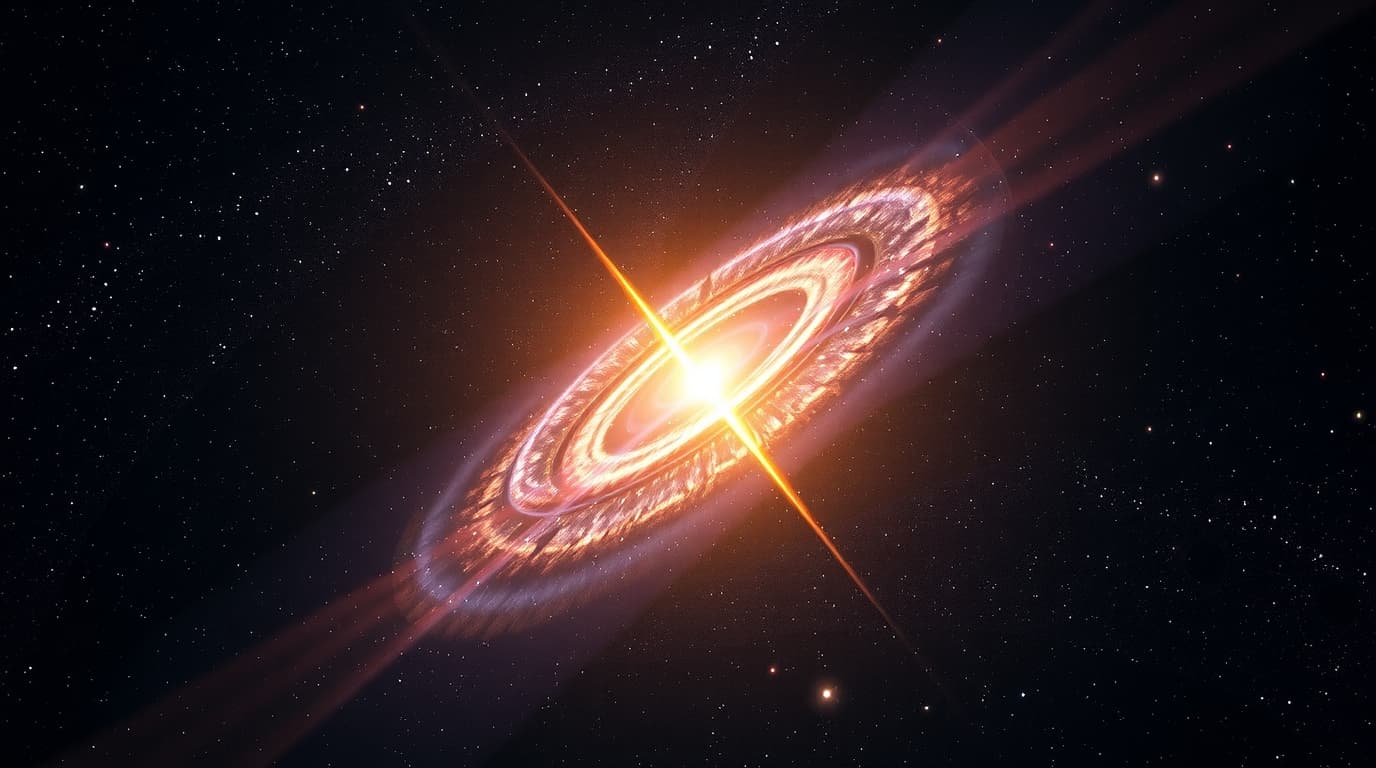
A quasar (short for “quasi-stellar object”) is an extremely luminous active galactic nucleus. At its center sits a supermassive black hole surrounded by an accretion disk—a swirling flow of gas and dust that heats up dramatically as it falls inward.
A quasar is not a black hole “glowing.” It’s the infalling material radiating enormous energy before it crosses the event horizon.
Why quasars shine so intensely
The key is efficiency. As matter spirals in, friction, compression, and magnetic fields convert gravitational energy into radiation. In some regimes, this process can turn a significant fraction of mass-energy into light—far more efficiently than stellar fusion.
Many quasars also launch relativistic jets: narrow beams of particles accelerated near the black hole that can radiate across the electromagnetic spectrum.
Why they once looked like stars
Early observations showed quasars as point sources with no visible host galaxy. The reason is straightforward: the nucleus can outshine the entire galaxy, especially at great distances. With better instruments and deeper exposures, astronomers confirmed quasars sit at the centers of galaxies.
How we know they’re so far away
Distance is commonly inferred using redshift. Known spectral lines appear shifted toward longer (redder) wavelengths because space itself expands between us and the source.
Higher redshift means we’re looking further back in time—making quasars exceptional probes of the young universe.
What quasars reveal about the early cosmos
Quasars matter because they:
- illuminate intergalactic gas, helping map matter between galaxies,
- trace how early galaxies grew and evolved,
- show that supermassive black holes existed very early—raising hard questions about how they grew so fast.
In other words, quasars are both evidence and challenge: they confirm the picture while forcing refinements to the theory.
Are quasars dangerous to us
Not remotely. The quasars we observe are extremely distant. For a quasar to threaten life in a planetary system, it would need to be very close—something not present in our local cosmic neighborhood.
Conclusion
Quasars are among astronomy’s brightest and most useful phenomena. They link black hole growth to galaxy evolution, showcase physics at extreme energies, and let us study epochs otherwise out of reach.
They may look like simple points of light, but they function like cosmic floodlights—illuminating the universe’s history.
Note: This article is educational and informational.