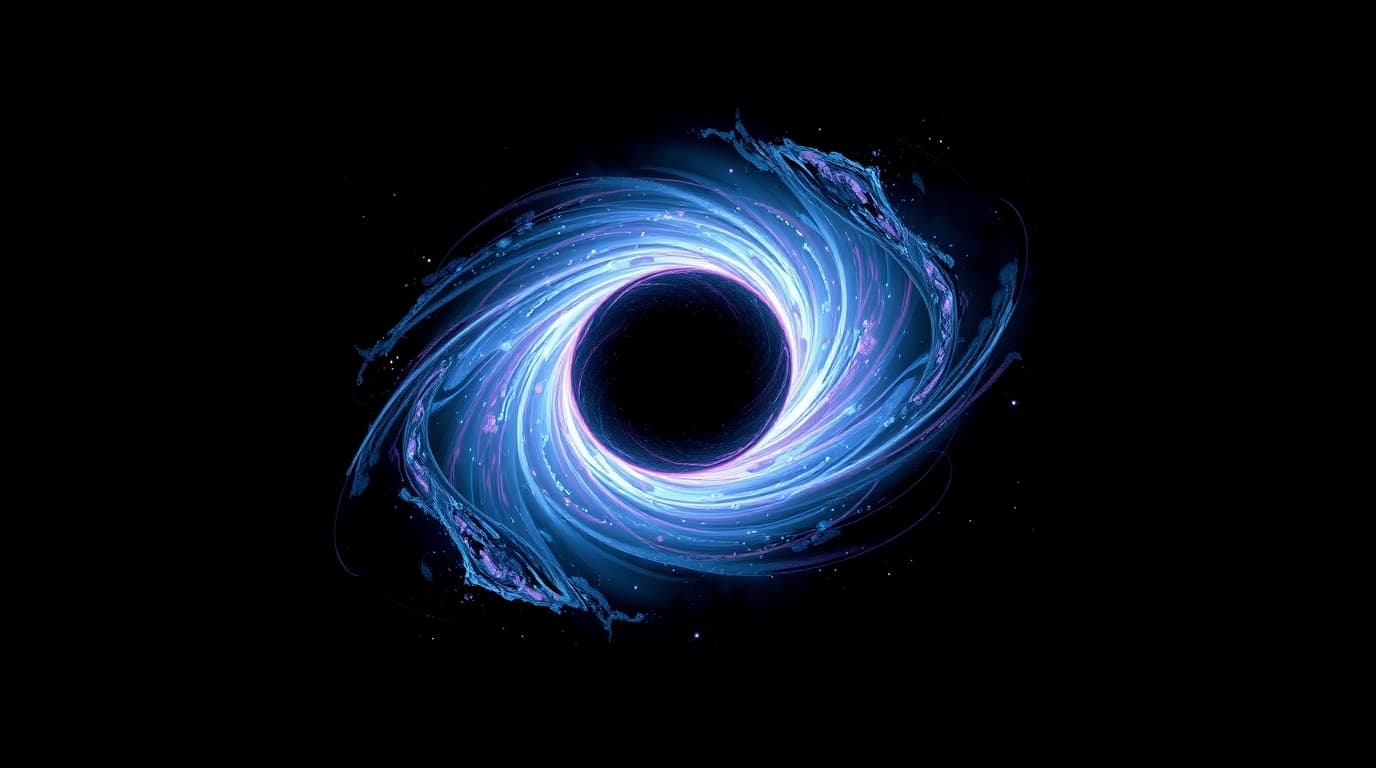
When you hear “black hole,” you might imagine something that “sucks everything in” and disappears into darkness. The truth is simpler—and more fascinating: a black hole is a region of space where gravity is so strong that even light can’t escape.
But if a black hole emits no light, a natural question follows: how do we know it exists at all?
The answer: we don’t usually look at the black hole directly—we look at the effects it has on its surroundings.
First: a black hole is not a “cosmic vacuum cleaner”
This is the biggest myth.
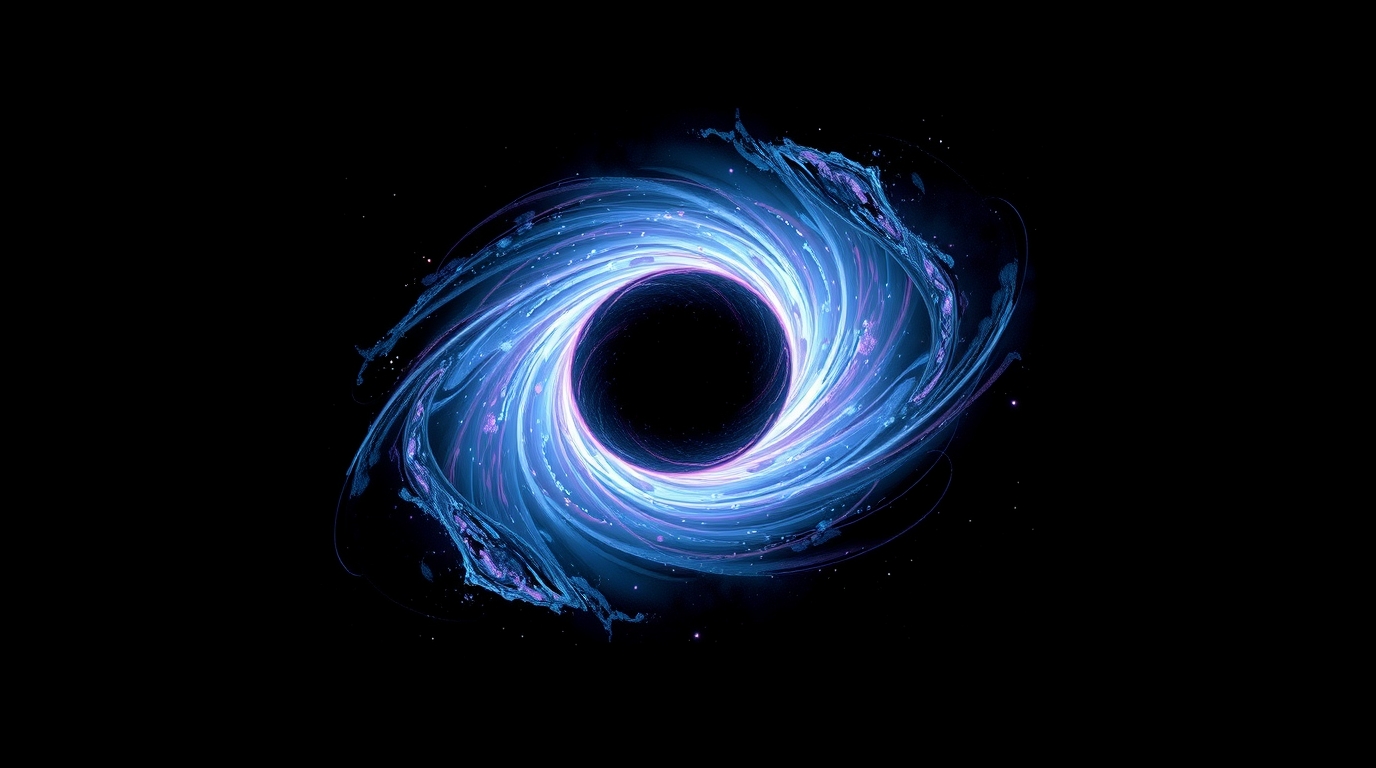
A black hole behaves like any other mass: if the Sun magically became a black hole of the same mass, Earth would not be swallowed—it would keep orbiting the same way. The difference is that the mass is packed into a much smaller region, so near the event horizon gravity becomes extreme.
Evidence #1: Stellar orbits — gravity “writes the truth”
One of the cleanest ways to “see the invisible” is to observe how stars move around something we can’t see.
If stars orbit an apparently empty point, and those orbits are:
- fast,
- tight,
- and consistently centered on the same location,
then there must be an enormous amount of mass in a tiny volume—exactly what we expect from a black hole (especially at a galaxy’s center).
Evidence #2: Accretion disks — matter shines instead of the hole
A black hole doesn’t shine, but matter falling toward it can shine intensely.
When gas and dust spiral in, they often form an accretion disk:
- friction heats the material,
- temperatures become extreme,
- and the system emits strongly—often in X-rays.
That’s why many black holes were first identified as powerful X-ray sources: we don’t see the hole, we see the glowing disk.
Evidence #3: X-ray binaries — the “invisible partner” in a system
In binary systems (two objects orbiting each other), sometimes a normal star “feeds” a compact companion.
By measuring:
- the visible star’s orbit,
- its speed and orbital period,
- and the X-ray brightness,
astronomers can estimate the mass of the unseen companion. If that mass exceeds what a neutron star can support, the best explanation is a black hole.
Evidence #4: Gravitational waves — the “sound” of black hole collisions
This is one of the most powerful modern confirmations.
When two black holes spiral together and merge, they generate ripples in spacetime—gravitational waves. Detectors on Earth don’t measure light; they measure tiny changes in length caused by these waves.
The wild part: from the signal you can infer:
- the masses,
- the merger speed,
- and the characteristic “ringdown” as the new black hole settles.
It’s like you can’t see two metal spheres, but you hear the impact and can tell their size from the sound.
Evidence #5: The black hole “shadow” — Event Horizon Telescope
The EHT made history: it didn’t “photograph” a black hole directly—it imaged light around it.
The result is a bright ring with a darker center: the so-called shadow.
That shadow isn’t a literal hole; it’s the projected region where photons are trapped or strongly bent by gravity.
It’s probably the closest thing to a “photo of a black hole” we can get in the everyday sense.
Evidence #6: Jets — cosmic “lasers” from the neighborhood of a black hole
Some black holes power enormous plasma jets shooting out from the poles.
Important: jets don’t come from inside the black hole—they arise from regions above the disk, where magnetic fields and rotation accelerate matter.
When you see jets stretching thousands of light-years, you know something extreme sits at the center—often a supermassive black hole.
Bonus: Gravitational lensing — light that “curves around” mass
Massive objects bend the path of light. Black holes (and the mass near them) can contribute to lensing effects: distortion, magnification, and sometimes multiple images of distant sources.
This is rarely the single “smoking gun” for one specific black hole, but it’s part of the broader toolkit used to map mass in the universe.
Conclusion
Black holes are a perfect example of scientific detective work: we may not see the “culprit” directly, but we see its footprints everywhere.
Combine:
- stellar orbits,
- accretion disks and X-rays,
- gravitational waves,
- and the EHT “shadow,”
and the case becomes overwhelming. Black holes are no longer exotic theory—they’re standard objects in modern astronomy.
Note: This is an educational, popular-science explanation.