Hubble vs James Webb: what’s the difference and why both still matter
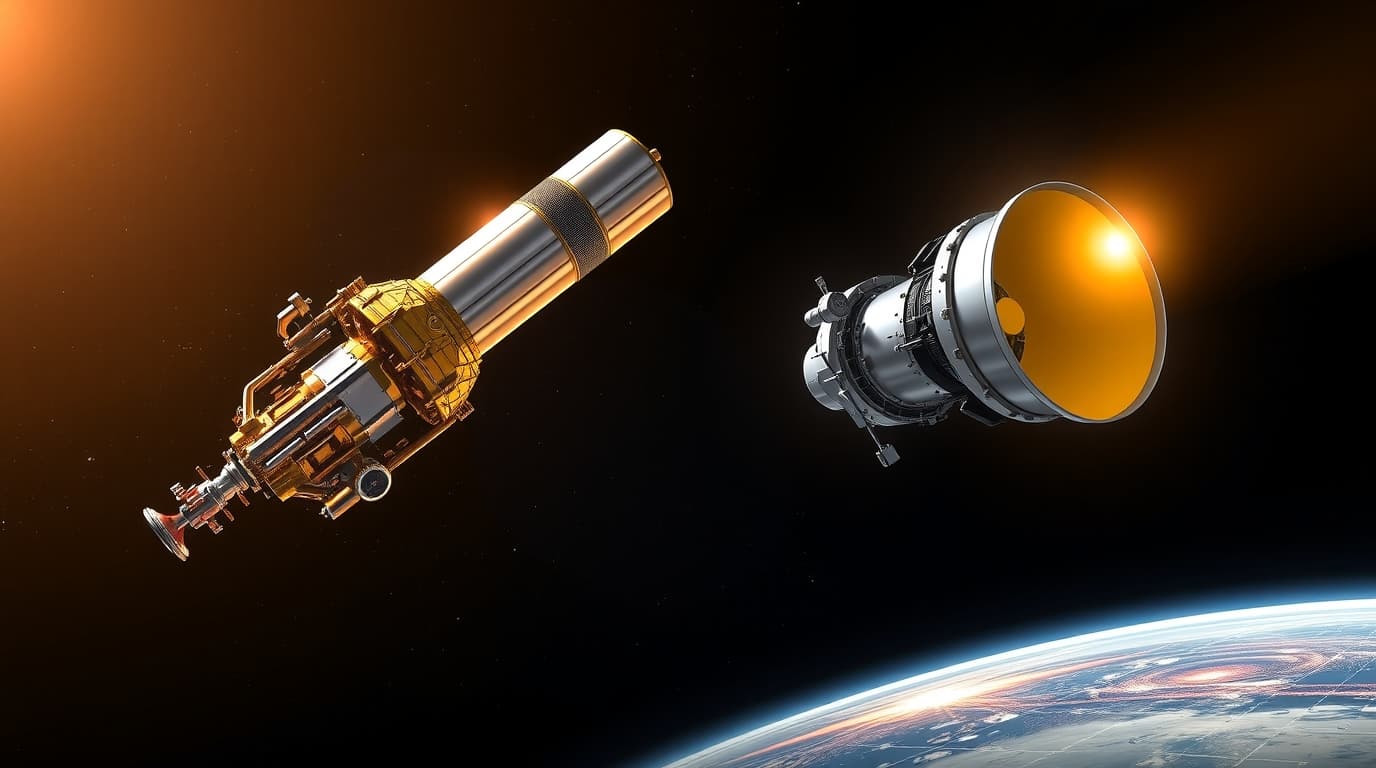
When people hear about the James Webb Space Telescope (JWST), they often think: “So it’s the new Hubble.” The real story is better: Hubble and Webb aren’t replacements — they’re a team. They observe different parts of light, operate from different locations in space, and complement each other extremely well.
So if you want a quick answer to “which one is better?” — it depends on what you want to see.
1) How they “see”: visible/UV vs infrared
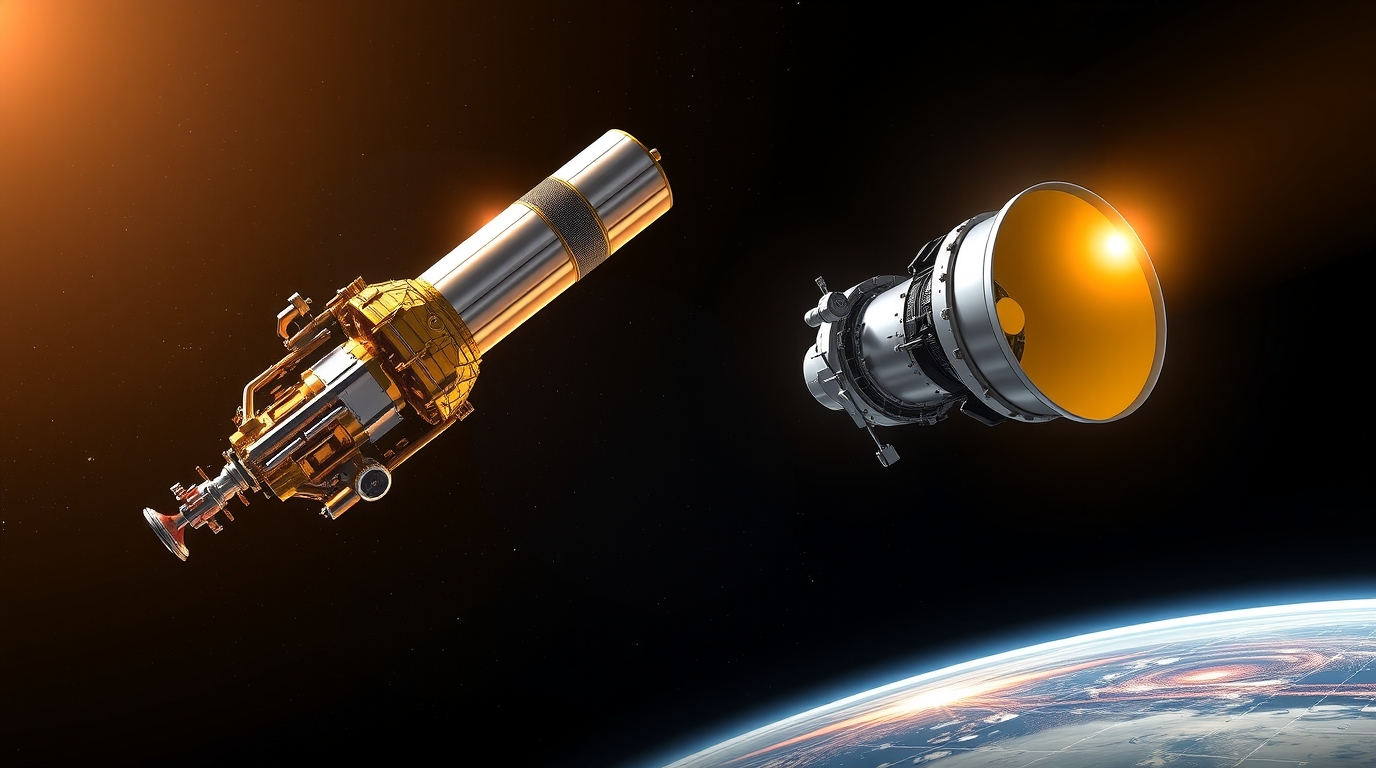
The most important difference is the type of light each telescope captures.
Hubble excels in visible light (what our eyes see), and it also has strong capabilities in ultraviolet (UV) plus a portion of near-infrared.
James Webb is designed for infrared (from near- to mid-infrared). That matters because infrared:
- passes through cosmic dust more easily (where visible light gets blocked),
- reveals cooler objects,
- and helps us study very distant galaxies whose light is “redshifted” as the universe expands.
In short: Hubble often delivers crystal-sharp “postcards,” while Webb often reveals what’s hiding behind the veil.
2) Where they are: low Earth orbit vs the L2 “quiet zone”
Hubble orbits Earth in low Earth orbit. That means:
- it’s relatively “close” (by space standards),
- and historically, it could be serviced by astronauts, which extended its life dramatically.
Webb operates far away near the Sun–Earth L2 point, a region that offers:
- a more stable thermal and lighting environment,
- but in practice, Webb is not serviceable the way Hubble was.
For infrared astronomy, that stable, colder environment is a major advantage.
3) Mirror and sensitivity: 2.4 m vs 6.5 m (what it actually means)
Webb’s primary mirror is much larger (6.5 m) than Hubble’s (2.4 m). A larger mirror collects more light, which allows Webb to detect fainter and more distant objects.
But it isn’t just size: Webb is engineered to operate at very low temperatures (with a massive sunshield). That’s critical because an infrared telescope can’t be “warm” — otherwise it would detect too much of its own heat.
4) What each telescope is best at (practical version)
Hubble is excellent for:
- sharp imaging in visible light (galaxies, nebulae, star clusters),
- UV observations (crucial for many astrophysical processes),
- long-term comparisons backed by decades of archival data.
James Webb is excellent for:
- looking through dust (stellar nurseries),
- studying the early universe (redshifted distant galaxies),
- probing exoplanet atmospheres through infrared signatures.
5) So which one is “better” — Hubble or Webb?
The best answer is: together.
- Hubble can reveal structure and detail in visible and UV light.
- Webb can uncover what’s hidden, cooler, farther — and often explain why something looks the way it does in a Hubble image.
That’s why astronomers frequently combine both: one telescope maps the scene, and the other provides deeper context and complementary data.
Conclusion
If you want one sentence to remember:
Hubble is a master of the visible universe and UV physics, while James Webb is a window into the infrared, dusty, and distant universe — and that’s why both still matter.
Disclaimer: This article is informational and is not a scientific paper or professional educational material.