Where Is Everybody? The Fermi Paradox and the Silence of the Universe
The universe is enormous—far larger than humanity once imagined. In our galaxy alone, the Milky Way, there are between 100 and 400 billion stars, and many of them host their own planetary systems. With numbers like these, it seems almost impossible that Earth is the only place where intelligent life has emerged.
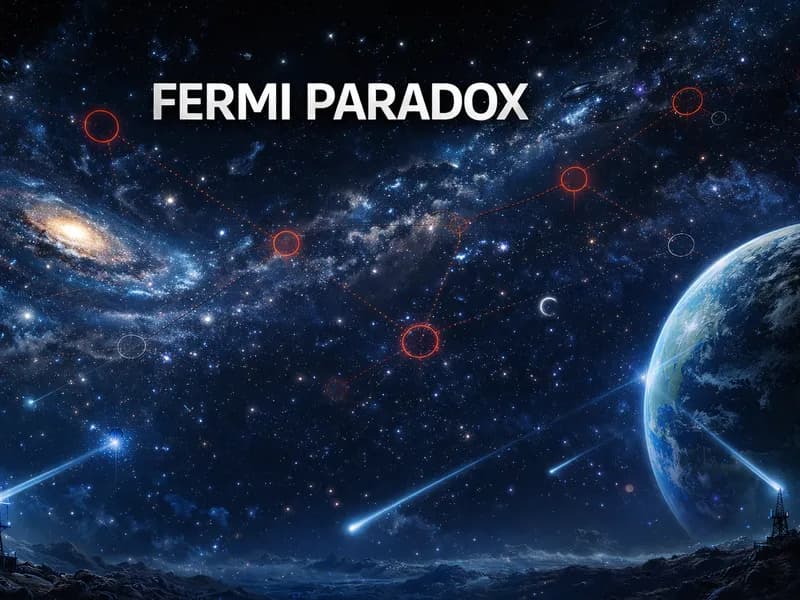
Yet despite decades of scientific exploration, powerful telescopes scanning deep space, and radio observatories listening for signals from distant civilizations, humanity has found no clear evidence of extraterrestrial intelligence. This contradiction between the high probability of life and the complete silence of the cosmos is known as the Fermi paradox.
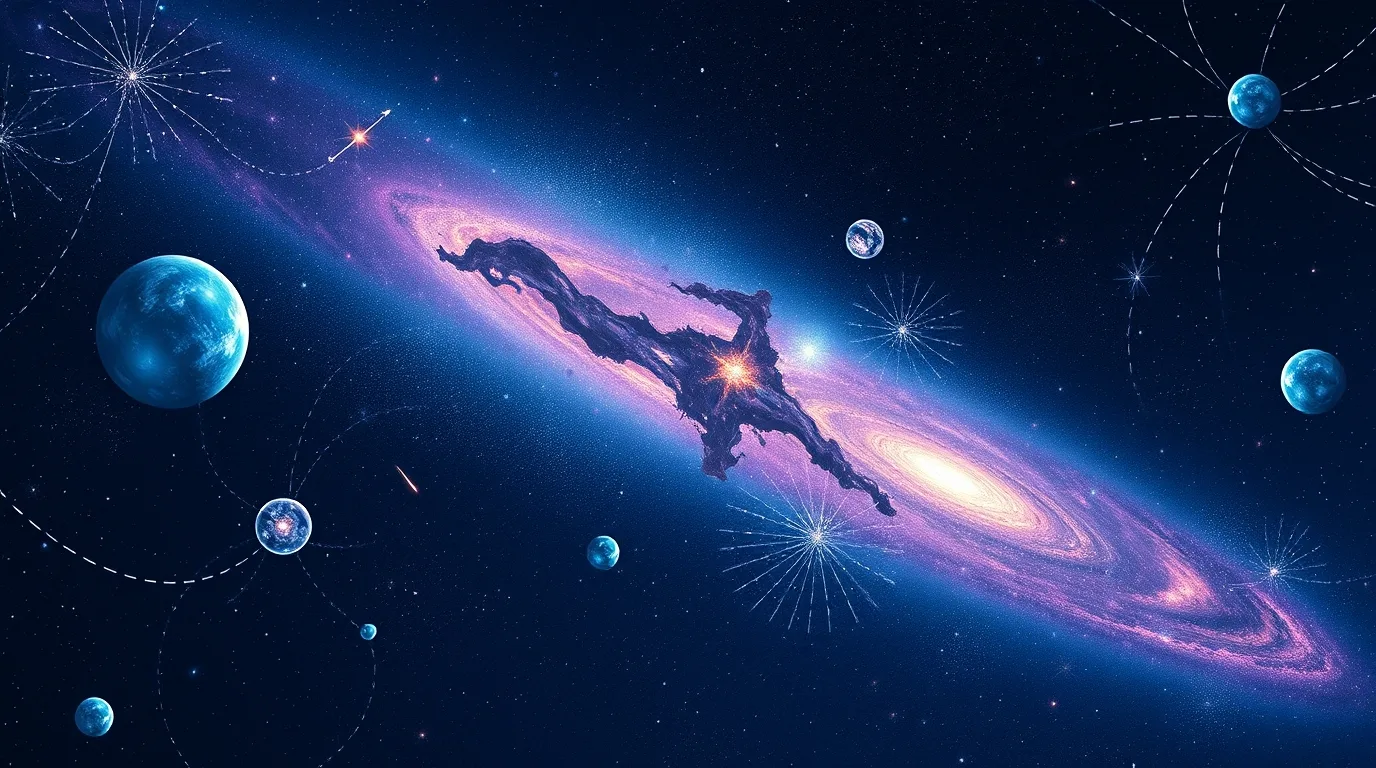
Visual illustration: InfoHelm
How the Fermi Paradox Originated
The concept dates back to 1950, when Italian-American physicist Enrico Fermi asked a simple question during a conversation with colleagues: “Where is everybody?”
Scientists already understood that the universe is billions of years old. If intelligent civilizations arise with any reasonable frequency, some of them could have had a massive technological head start over humanity. Even a relatively slow expansion across the galaxy could theoretically take only a few million years—a very short period on cosmic timescales.
In other words, if intelligent civilizations are common, we might expect to see signs of them everywhere. But so far, the universe appears silent.
How Likely Is Life in the Universe?
One way scientists attempt to estimate the number of intelligent civilizations is through the Drake Equation. This formula estimates how many civilizations in our galaxy might be capable of sending detectable signals.
The equation considers factors such as:
- the rate of star formation in the galaxy
- the fraction of stars that have planets
- the number of planets capable of supporting life
- the probability that life becomes intelligent
- the lifetime of technological civilizations
While many of these values remain uncertain, modern astronomical discoveries have revealed that planets are extremely common. Thousands of exoplanets have been discovered in recent decades, including several located within the so-called habitable zone of their stars.
This suggests that potentially life-friendly worlds could exist in enormous numbers.
The Great Filter Hypothesis
One explanation for the Fermi paradox is the idea of the Great Filter. According to this hypothesis, somewhere in the evolutionary path from simple chemistry to advanced civilization lies a very difficult step that most life forms never pass.
This barrier could occur at many stages—from the formation of complex cells to the development of advanced technology capable of interstellar communication.
If the Great Filter occurs early in evolution, intelligent life may simply be extremely rare. If it lies ahead in the future, it might mean that most civilizations destroy themselves before they become spacefaring.
Perhaps We Simply Cannot Detect Them
Another possibility is that extraterrestrial civilizations exist, but we simply cannot detect them yet.
Search programs like SETI primarily focus on radio signals. However, advanced civilizations might communicate using technologies far beyond our current understanding—such as laser communication, exotic physics, or methods we have not even imagined.
Additionally, technological civilizations might exist only for relatively short periods of time. If a civilization’s technological phase lasts only a few thousand years, the chances of two civilizations overlapping in time could be very small.
What If Humanity Is Early?
A fascinating possibility is that humanity may be among the first intelligent civilizations to emerge in our galaxy.
Although the universe is about 13.8 billion years old, many stars similar to our Sun formed much later in cosmic history. Some scientists suggest that stable planetary systems capable of supporting complex life may have become common only relatively recently.
If that is true, intelligent life might just now be beginning to appear across the galaxy.
Conclusion
The Fermi paradox remains one of the greatest mysteries in modern science. Statistics suggest that life could be widespread throughout the universe, yet we have found no clear evidence of other civilizations.
Perhaps we are alone. Perhaps we are early. Or perhaps the cosmos is full of life that we have simply not discovered yet.
What we do know is that the universe is vast—and humanity has only just begun to explore it.
Note: This article is educational and informational.