When we say “we discovered a new planet,” most people imagine a telescope taking a picture like a camera. The reality is more interesting: we usually don’t see exoplanets directly—we identify them by the traces they leave on their star.
It’s like being in the dark and not seeing a person, but noticing:
- a shadow crossing a lamp,
- a glass shifting on the table,
- or footsteps that reveal someone is there.
In astronomy, that “trace” is typically light and gravity.
Method #1: Transit — the planet causes a tiny “eclipse”
This is the most famous method and the reason you often hear about a “dip in starlight.”
How it works:
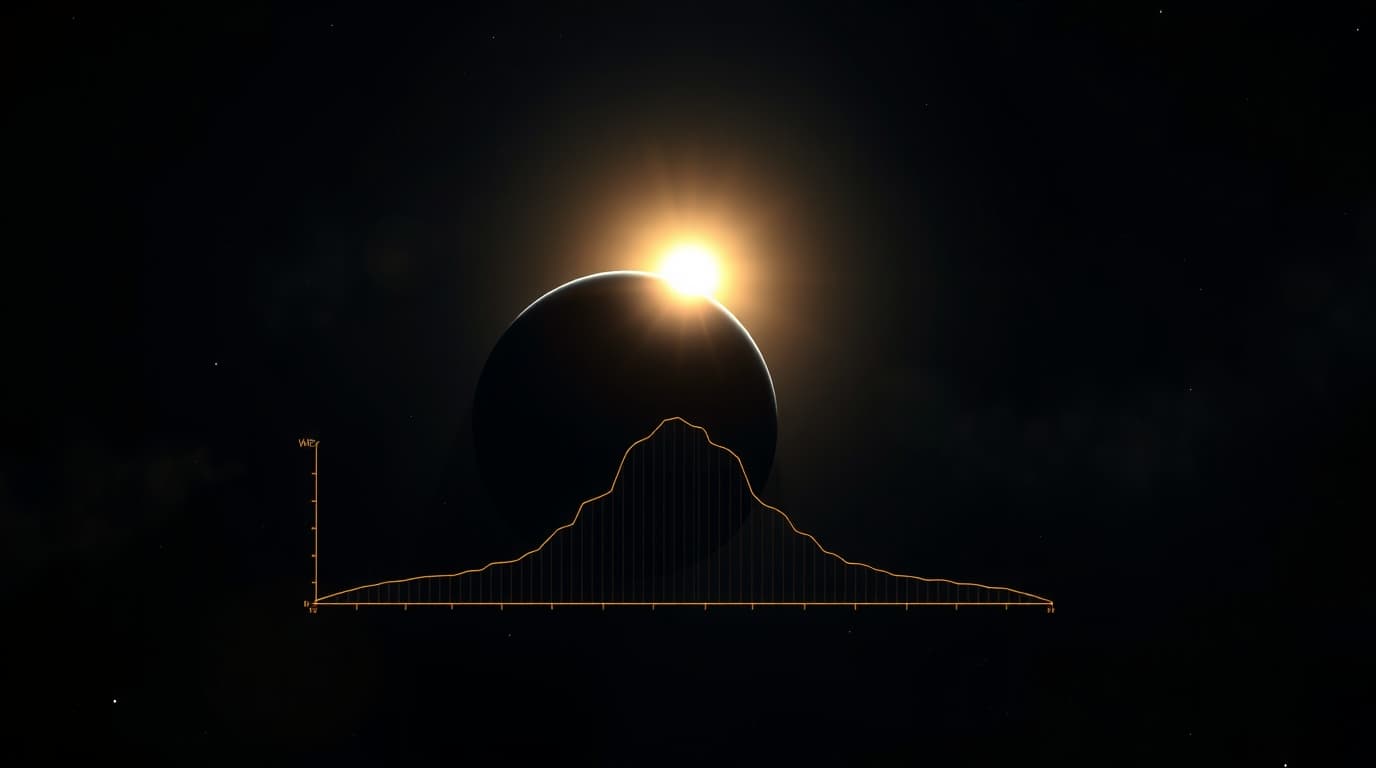
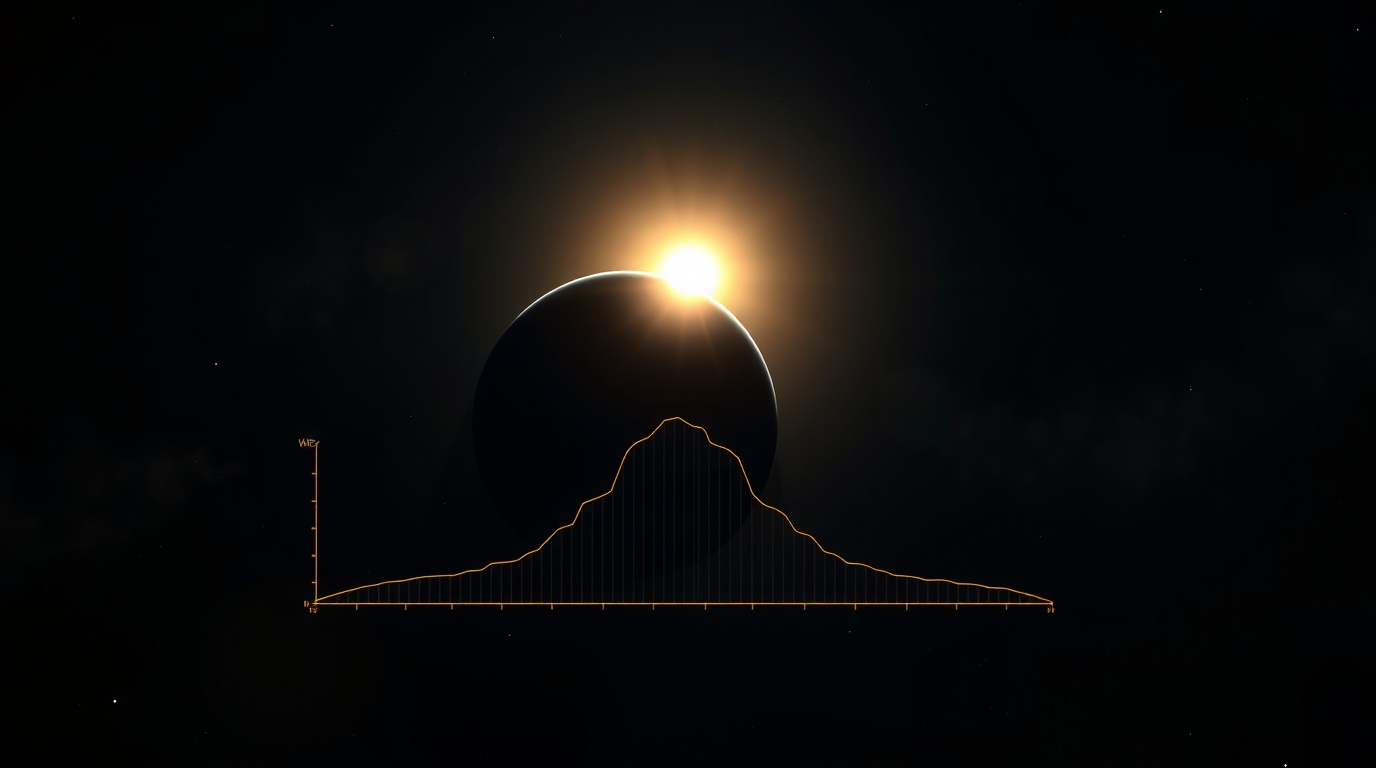
- the planet passes in front of the star (from our viewpoint),
- the star becomes slightly dimmer,
- instruments measure the dip and draw a light curve.
What we can learn from transits:
- the planet’s size (how much light it blocks),
- its orbital period (how often the dip repeats),
- and, if we also know its mass from another method, we can estimate density—a clue to whether it’s rocky or gaseous.
Drawback: the geometry has to line up. If the orbit isn’t edge-on to us, we won’t see a transit.
Method #2: Radial velocity — the star “wobbles”
A planet and its star actually orbit their shared center of mass. The star is huge so it moves only a little—but enough for us to detect.
How we measure it:
- we observe the star’s spectral lines,
- due to the Doppler effect, those lines shift slightly as the star moves toward/away from us.
What we get:
- the planet’s minimum mass (limited by the orbit’s tilt),
- an excellent way to confirm transit candidates.
Advantage: doesn’t require perfect alignment like transits, but it demands extremely precise instruments.
Method #3: Direct imaging — rare, but spectacular
This is what people picture: “here’s the planet’s photo.”
The problem: a star is blindingly bright compared to its planet.
That’s why astronomers use:
- coronagraphs (to block the star’s light),
- sophisticated image processing,
- and often target large planets far from their stars, where contrast is more favorable.
What we can get:
- light from the planet itself,
- sometimes even clues about its atmosphere (via spectra).
Drawback: it’s hard—so it’s less common.
Method #4: Gravitational microlensing — a cosmic “zoom”
If a foreground star (with a planet) passes almost perfectly in front of a more distant background star, gravity can magnify the background star’s light. The planet adds a smaller, distinct “bump” in the brightness curve.
What’s special about microlensing:
- it can detect planets far from their stars,
- even “rogue” planets that don’t orbit any star.
Drawback: the event is one-time—once it’s over, it’s difficult to repeat the measurement.
Method #5: Astrometry — measuring tiny shifts on the sky
This is wobble detection too, but instead of Doppler shifts (velocity), we measure the star’s position on the sky over time.
Advantage: strong for massive planets and wide orbits.
Drawback: requires extreme positional precision.
Okay, but… how do we know it isn’t a false alarm?
In science, it’s normal for an early signal to be a “candidate,” and only later become confirmed.
Common sources of false positives:
- two stars blended in the same field (a “fake” transit),
- star spots and stellar pulsations (can mimic signals),
- instrument noise.
That’s why astronomers often combine methods:
- transit + radial velocity,
- transit + timing variations (TTV),
- direct imaging + long-term monitoring.
The next level: atmospheres and “is it habitable?”
With transits, we can sometimes measure an atmospheric spectrum: a small fraction of starlight passes through the planet’s atmosphere and picks up chemical fingerprints.
That’s where the big questions start:
- is there water vapor?
- what’s the composition?
- what about clouds?
- and the most sensitive question: biosignatures (possible signs of life)
Important note: even if we detect a molecule associated with life on Earth, it’s not automatic proof. Natural processes can produce similar signals, so interpretation requires extreme caution.
Conclusion
Exoplanets are a perfect example of how science works without “magic”: we can’t always see things directly, but by measuring light and gravity with high precision, we can reconstruct entire planetary systems.
And that may be the most beautiful part: from a barely noticeable dip in brightness or a microscopic Doppler shift, we “map” worlds we may never visit—yet understand better with every new observation.
Note: This is an educational, popular-science explanation of detection methods.