Superconductors and optical fibers – from copper wires to the internet of the future
Most of us still instinctively imagine Wi-Fi, 4G/5G or a copper cable going into the router when we hear the word “internet”.
In reality, the majority of global traffic travels through thousands of kilometers of optical fibers – glass threads thinner than a hair, buried underground or lying on the ocean floor.
At the same time, physicists in laboratories are developing superconductors – materials that, at low temperatures, conduct electricity with zero electrical resistance. That means: no losses, no heating, no energy wasted as heat in the cables.
When you connect these two worlds – light in fibers and current without resistance – you get one of the most interesting visions of future technology:
- faster and more stable internet,
- quantum communication networks,
- power systems with minimal losses,
- completely new types of computers.
In this article we’ll walk through the basics: what superconductors are, how optical fibers work and why physicists are building exotic hybrids that combine both.
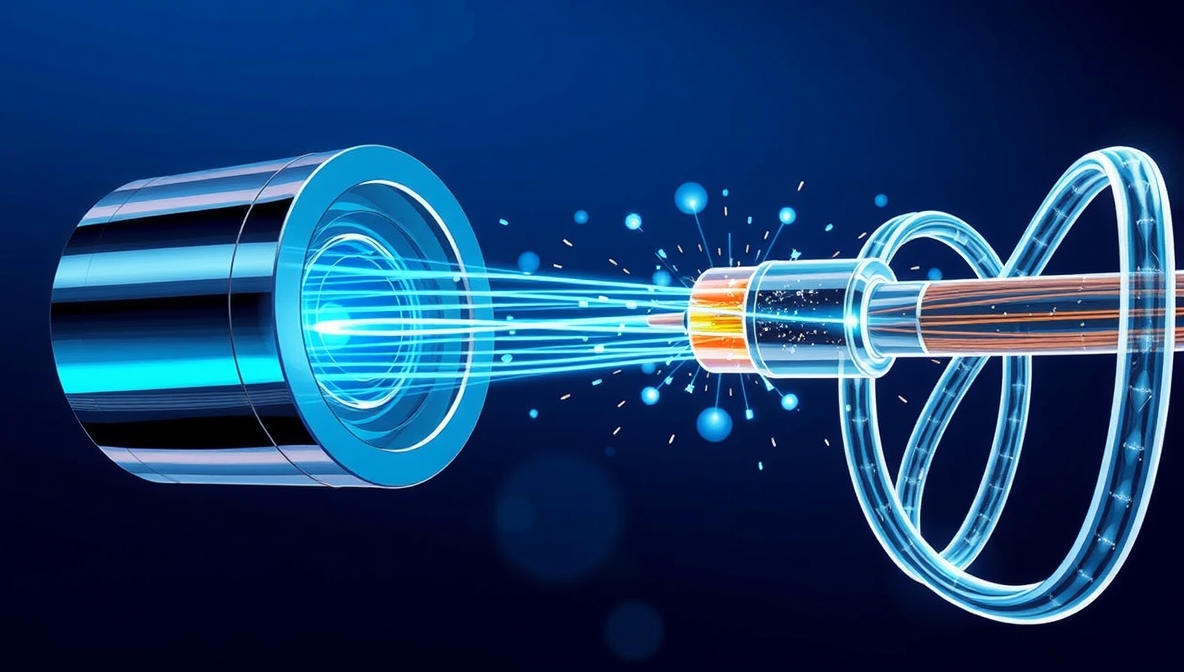
1. What are superconductors (and why everyone is chasing “room temperature”)
In ordinary metals (copper, aluminium) electrons constantly collide with the crystal lattice of atoms → energy turns into heat → wires warm up and part of the energy is lost.
A superconductor is a special material which, below a certain critical temperature:
- has exactly zero electrical resistance,
- can carry huge currents without heating up,
- expels magnetic fields from its interior (the Meissner effect).
This enables things like:
- MRI magnets in hospitals,
- levitating trains (maglev),
- superconducting magnets for particle accelerators (CERN).
But today physics aims much higher:
we’re looking for superconductors that work at ever higher temperatures, ideally close to room temperature. That would mean:
- near-lossless cables in power grids,
- superconducting components in servers and data centers,
- quantum processors with much simpler cooling.
For now, most “high-temperature” superconductors still work far below zero (in kelvins), with liquid nitrogen or helium for cooling.
But the pace of research and the variety of materials (cuprates, iron-based, nickelates, hydrides under huge pressure…) show that this is one of the hottest fields in modern physics.
2. Optical fibers – how light carries the internet
Unlike copper cables where electricity flows, in an optical fiber light travels – laser pulses bouncing inside the fiber core and covering thousands of kilometers with very low losses.
The magic comes from:
- an ultra-pure glass core with a precisely tuned refractive index,
- total internal reflection – light “walks” through the fiber without leaking out,
- the ability to send multiple wavelengths (different “colors” of light) at the same time – called WDM, wavelength-division multiplexing.
The result:
- today the capacity of a single fiber is measured in terabits per second,
- under the oceans lie cables that carry almost all of our messages, video calls, gaming packets and AI requests.
And again, researchers don’t stop here – they’re working on exotic versions of optical fibers:
- hollow-core fibers, where light travels through air instead of glass,
- fibers with multiple cores, where one physical fiber carries many independent channels,
- structures using photonic crystals and special core shapes to reduce latency and losses even further.
3. Where superconductors and optical fibers meet
At first glance, one world is “current in solid matter”, the other is “light in glass”.
In practice, modern infrastructure increasingly needs their combination.
3.1. Superconducting single-photon detectors
In quantum communication and quantum internet projects, the key is to detect single photons that carry quantum information (quantum bits – qubits).
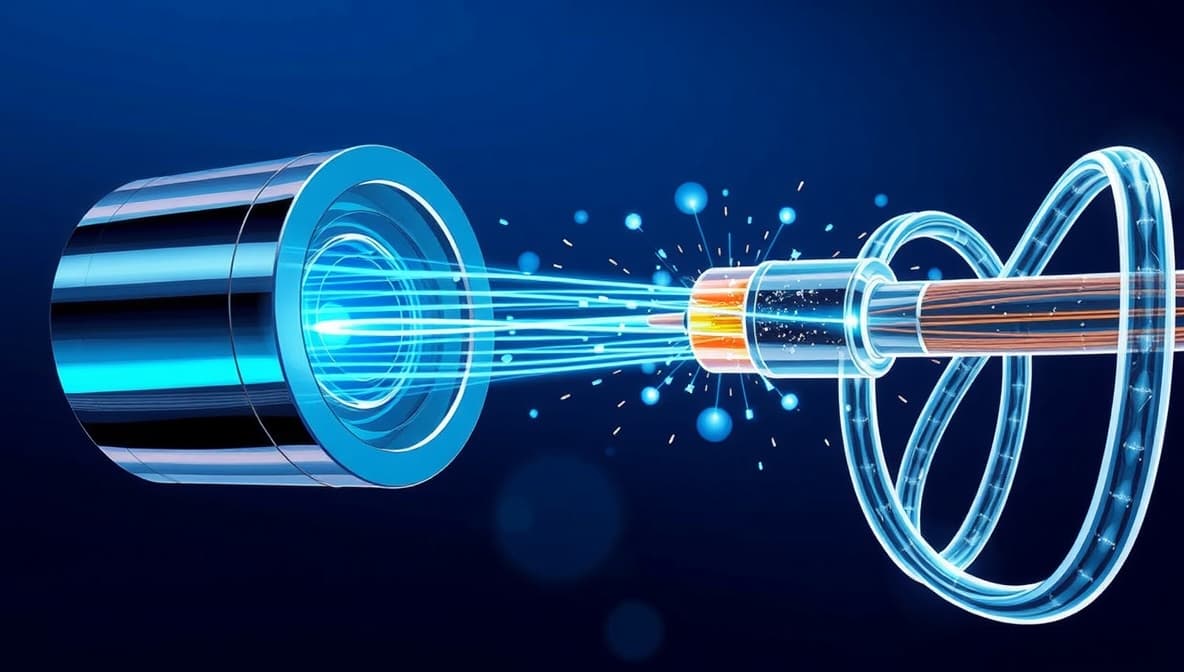
This is where superconducting SNSPD detectors (superconducting nanowire single-photon detectors) come in:
- they are built from ultra-thin superconducting wires at cryogenic temperatures,
- they can “feel” the arrival of a single photon from an optical fiber,
- their error rate is extremely low.
Without such detectors, a practical quantum internet would be almost impossible.
3.2. Superconducting filters and processors for telecom
Superconductors are also used in:
- very selective RF filters in telecom equipment,
- experimental superconducting logic circuits (e.g. RSFQ technology) for ultra-fast digital systems.
Imagine a future data center where:
- light comes through optical fibers directly to the chip,
- inside the chip signals are processed by superconducting logic with almost zero dissipation.
That would be a huge revolution for AI, cloud computing and everything currently constrained by energy and cooling in big server farms.
4. Quantum internet: when photons in fibers carry quantum keys
Another exotic direction is the quantum internet – a network that uses quantum mechanics for:
- quantum key distribution (QKD) – cryptographic keys exchanged using quantum states of photons,
- communication that is impossible to eavesdrop on without being detected.
Here optical fibers + superconducting detectors + quantum repeaters form the team:
- optical fibers carry quantum photons across and between cities,
- superconducting detectors catch those photons at the receiving end,
- quantum repeaters (still under development) should one day enable links over hundreds or thousands of kilometers without losing quantum information.
For now these are mostly experimental networks – pilot links between universities, banks and government institutions.
But the principle is clear: light in optics + superconducting components at key points.
5. What all this means in practice
For the average user all this sounds like sci-fi, but the consequences will be very down-to-earth:
-
Faster and more reliable internet “behind the scenes”
- advanced optical fibers reduce latency and losses in backbone networks,
- better telecom components (including superconducting ones) increase capacity without exploding energy use.
-
Possible new types of data centers
- if superconducting technologies become more practical, data centers could use far less power per operation,
- today a huge part of AI power consumption goes into cooling – superconductors attack that problem directly.
-
Communication security
- quantum internet doesn’t mean “faster” internet, but more secure against eavesdropping,
- in a world that relies more and more on digital infrastructure, this could become a critical technology.
-
Power grids
- superconducting cables are already being tested in some cities as part of power networks,
- in the future they could carry huge amounts of electricity across long distances with almost no losses.
6. A good way to leave “space” without leaving science
Up to now, our “science & space” topics often meant:
- exoplanets,
- black holes,
- space missions and telescopes.
This story takes a different angle:
- we’re still firmly in fundamental physics (quantum mechanics, cryogenics, photonics),
- but the topic is very earthly – cables, internet, electricity, data centers.
It’s a nice bridge to future articles on:
- quantum sensors,
- MRI and medical physics,
- new materials,
- bio-physics and AI in drug discovery.
Conclusion
Superconductors and optical fibers look like two separate worlds – one deals with current flowing without resistance, the other with light racing through glass.
In reality they’re becoming pillars of the future internet and energy infrastructure:
- superconductors as a path to systems with minimal losses and powerful magnetic and logic components,
- optical fibers as the bloodstream of global communication, getting faster and more sophisticated every year,
- their combination in the form of quantum networks, superconducting detectors and exotic photonic structures.
For us as users, the key point is that this is not just “lab playtime” –
but technology that will, over the next decades, decide:
- how fast we communicate,
- how much energy our digital world consumes,
- and how safely our information is stored in the age of ubiquitous AI.
Disclaimer: This article is for informational purposes only and does not constitute financial, investment, legal, medical or any other form of professional advice.