JWST may be seeing the universe’s first stars: the mysterious galaxy LAP1-B
For decades, astronomers have been hunting for the first generation of stars – the so-called Population III, born shortly after the Big Bang from almost pure hydrogen and helium. These stars were so massive and short-lived that they disappeared long ago, so we can’t “catch them in the act” – only their fingerprints in the light of very young galaxies.
Now the James Webb Space Telescope (JWST) may have taken that historic step. In the ultra-faint galaxy LAP1-B, about 13 billion light-years away, a team of astronomers has found signals that match the conditions expected for Population III stars. It is not yet a final confirmation, but it is the strongest candidate so far.
There’s an extra twist: LAP1-B is so faint that without a bit of help from nature we would probably have missed it completely. Its light is amplified by a gravitational lens – the massive galaxy cluster MACS J0416 between us and LAP1-B, which warps space and acts as a natural telescope.
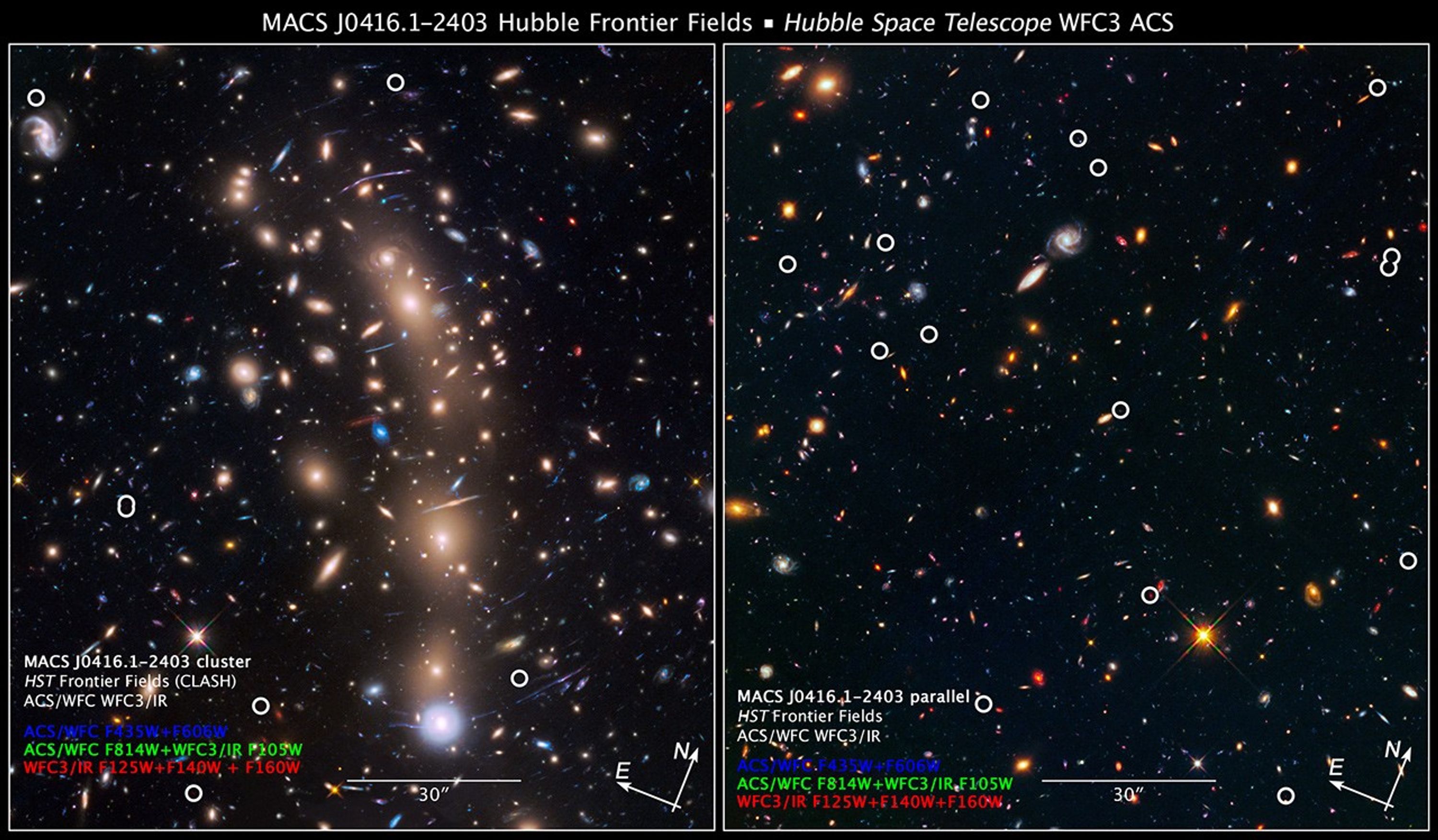
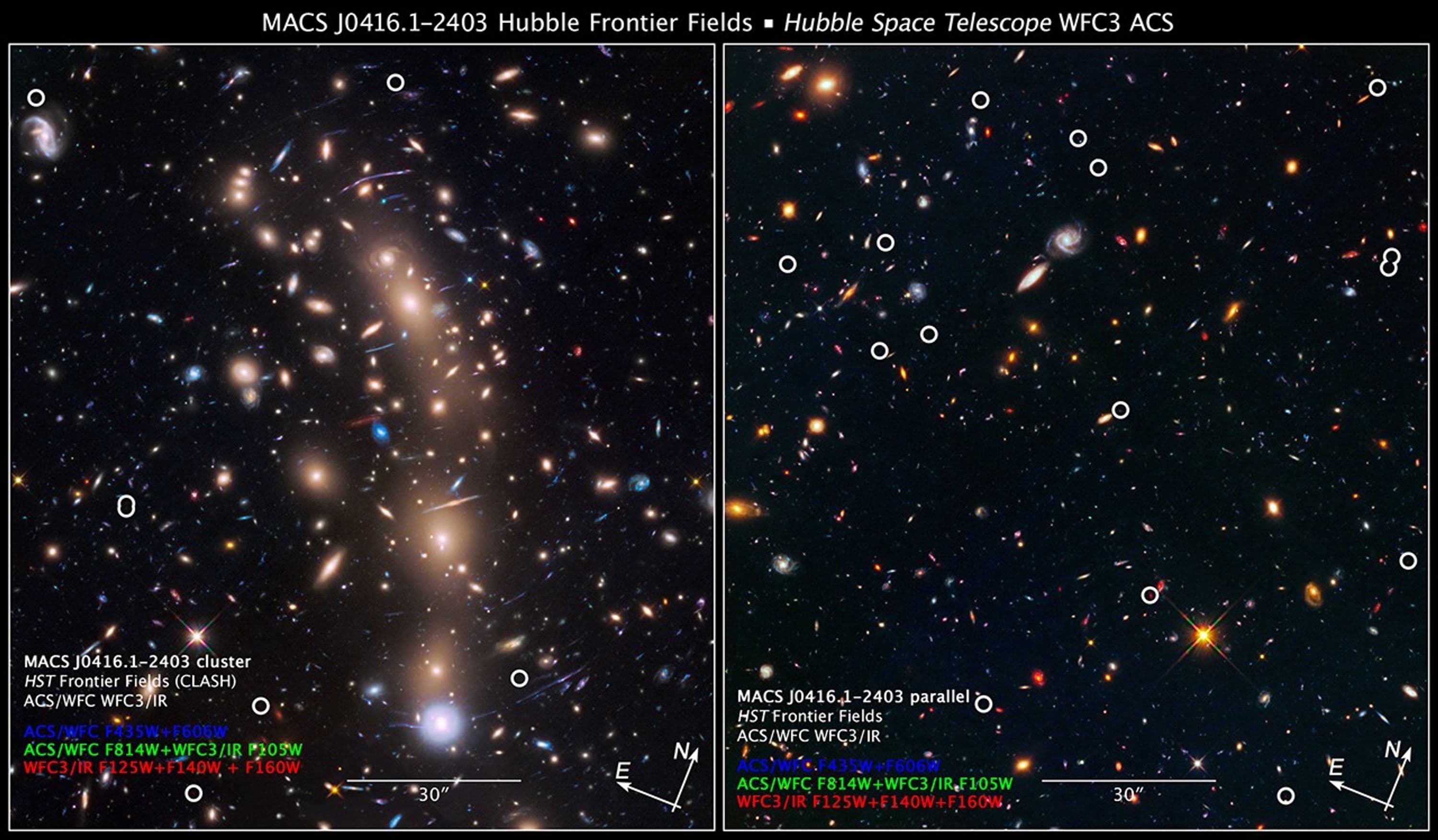
Galaxy cluster MACS J0416.1–2403 (left) and the parallel field (right) from the Hubble Frontier Fields program. Circles mark some of the most distant galaxies whose light has been magnified by gravitational lensing. Credit: NASA, ESA, Z. Levay (STScI/AURA); acknowledgment: L. Infante (Pontificia Universidad Católica de Chile).
What are Population III stars and why do they matter?
In the cosmological story, stars come in “generations”:
-
Population III – the very first stars in the universe, made almost entirely of hydrogen and helium (plus traces of lithium) produced in the Big Bang. In theory, they were:
- much more massive than most stars today (often tens or even hundreds of solar masses),
- extremely bright in the ultraviolet,
- very short-lived – surviving only a few million years before ending as enormous supernovae.
-
Population II – the next generation of stars, already enriched with “heavier” elements (oxygen, carbon, iron, etc.) created in Population III explosions.
-
Population I – the youngest, metal-rich stars like our Sun, forming later in gas that has been recycled and enriched many times.
Because Population III stars no longer exist, astronomers search for young galaxies whose light carries the imprint of environments dominated by such stars: almost no heavy elements, and very “hard” (energetic) UV radiation that ionizes gas in a distinctive way.
Thanks to its huge mirror and sensitivity in the infrared, JWST was built precisely to probe those earliest cosmic epochs – the so-called epoch of reionization, up to about a billion years after the Big Bang, when the first stars and galaxies “switched on the lights” in a dark universe.
LAP1-B: an ultra-faint, chemically “primordial” galaxy
The galaxy LAP1-B was found in JWST data as an extremely faint but chemically pristine system. Spectroscopic measurements place it at a redshift of z ≈ 6.63, meaning we see it as it was about 800 million years after the Big Bang.
Several features make LAP1-B stand out as a “Pop III bingo card”:
- Record-low oxygen abundance – only about 0.4% of the Sun’s oxygen content, making it the most chemically primitive star-forming galaxy known at any epoch.
- Extremely hard ionizing radiation – the spectral signature indicates that the gas is lit by a very energetic source of UV photons, just what we’d expect from very massive, nearly metal-free stars, and very hard to explain with “ordinary” more metal-rich stellar populations or an active black hole.
- Unusual carbon-to-oxygen ratio – a high C/O value at such low metallicity fits the nucleosynthesis patterns of stars born without initial heavy elements, another theoretical fingerprint of Population III.
- Very low total stellar mass – JWST does not detect a stellar continuum, which limits the total stellar mass to less than ~2700 solar masses, while gas dynamics point to a much more massive dark-matter halo of about 5×10⁷ M☉. In other words, we’re seeing a tiny stellar cluster sitting in a deep gravitational well.
Based on these data, one team (Nakajima et al.) describes LAP1-B as the most primitive star-forming galaxy yet observed, while another team (Visbal, Hazlett & Bryan) goes further and argues that this is the first object to meet three key theoretical criteria for Population III:
- formation in an extremely low-metallicity halo with a low virial temperature,
- a top-heavy stellar mass distribution (dominated by very massive stars),
- a small cluster with only a few thousand solar masses in those massive stars.
In short, LAP1-B looks like the real-world version of the theoretical picture of where the first stars should form.
How JWST and gravitational lenses build a “cosmic telescope”
Even so, LAP1-B would be completely invisible to us without a fortunate cosmic alignment. Between us and the galaxy lies the massive cluster MACS J0416, about 4.3 billion light-years away. Its enormous mass curves spacetime and acts as a gravitational lens, magnifying and distorting the light of still more distant objects behind it.
For LAP1-B, models suggest that its light is boosted by a factor of roughly 100. Without that magnification, even JWST would struggle to detect such a faint object at that distance.
This combination – a super-sensitive infrared telescope plus a gravitational lens – gives us, for the first time, access to:
- ultra-faint, chemically almost untouched galaxies,
- tiny stellar clusters that resemble the “proto-star factories” of the early universe.
That’s why many researchers describe LAP1-B as “the tip of the iceberg” – if we can see one such system in this field, JWST combined with other lensing clusters is likely hiding many more similar candidates.
How close are we really to finding the first stars?
Popular headlines easily fall into the trap of saying “JWST has definitively found the first stars.” Scientists are much more cautious. Even though LAP1-B fits theory remarkably well, serious caveats remain:
- We don’t see individual stars, only the combined effect of their light and the ionized gas – leaving room for alternative explanations, such as extremely metal-poor gas illuminated by a slightly different stellar population.
- It is very hard to prove that metals are truly absent, because they might be present below the detection threshold of our instruments. As the authors themselves point out: “absence of evidence is not evidence of absence.”
- Previous candidates for Population III have, under closer scrutiny, turned out to be extremely metal-poor but ordinary Population II systems – that is, they still had enough heavy elements to fall short of true zero-metallicity.
That’s why the scientific papers use careful language like
“the first system consistent with theoretical predictions for Population III”, not “definitive detection of the first stars.”
What would it take to move from “candidate” to “confirmed”?
- even deeper JWST spectra that push the limits on metal abundances further down,
- additional spectral lines (for example, the absence of certain oxygen features) as independent confirmation,
- and ideally the discovery of another similar system with the same properties in a different field.
If upcoming observing campaigns confirm that LAP1-B is truly dominated by stars formed from an almost completely pristine mixture of hydrogen and helium, this would be the first direct catch of Population III in action – a genuine game-changer for cosmology.
Conclusion
The discovery of LAP1-B shows that the hunt for the universe’s first stars has entered a new phase. Thanks to the James Webb Space Telescope and natural gravitational lenses like the cluster MACS J0416, we can finally study the most primitive stellar systems that theory has been predicting for decades.
We still don’t have a 100% confirmation that LAP1-B is powered by Population III stars, but:
- its chemical purity,
- extremely hard ionizing radiation,
- and compact, massive stellar cluster inside a dark-matter halo
make it by far the best candidate yet.
Whatever the final verdict, this galaxy has already become a new cosmic laboratory – a place where we test how the first stars formed, how they ignited the epoch of reionization, and how the universe went from its first light to the chemically rich cosmos that today builds planets, biospheres and, eventually, us.
Disclaimer: This article is for informational purposes only. It does not represent an official statement from any space agency and does not guarantee the absolute accuracy of long-term cosmological models and interpretations.