3I/ATLAS – interstellar comet or something else entirely?
For the third time in history, we’ve been visited by an object that doesn’t belong to our Solar System.
After ‘Oumuamua and 2I/Borisov, along comes 3I/ATLAS – an object so strange that it quickly generated both new science and a fresh wave of conspiracy theories.
Officially, 3I/ATLAS is an “interstellar comet” discovered in July 2025 within the Hawaiian–Chilean ATLAS project. Its orbit is clearly hyperbolic, which means it comes from interstellar space and will never return.
Unofficially, social media is on fire:
is this just a frozen chunk of ice and dust, or a probe from another civilization?
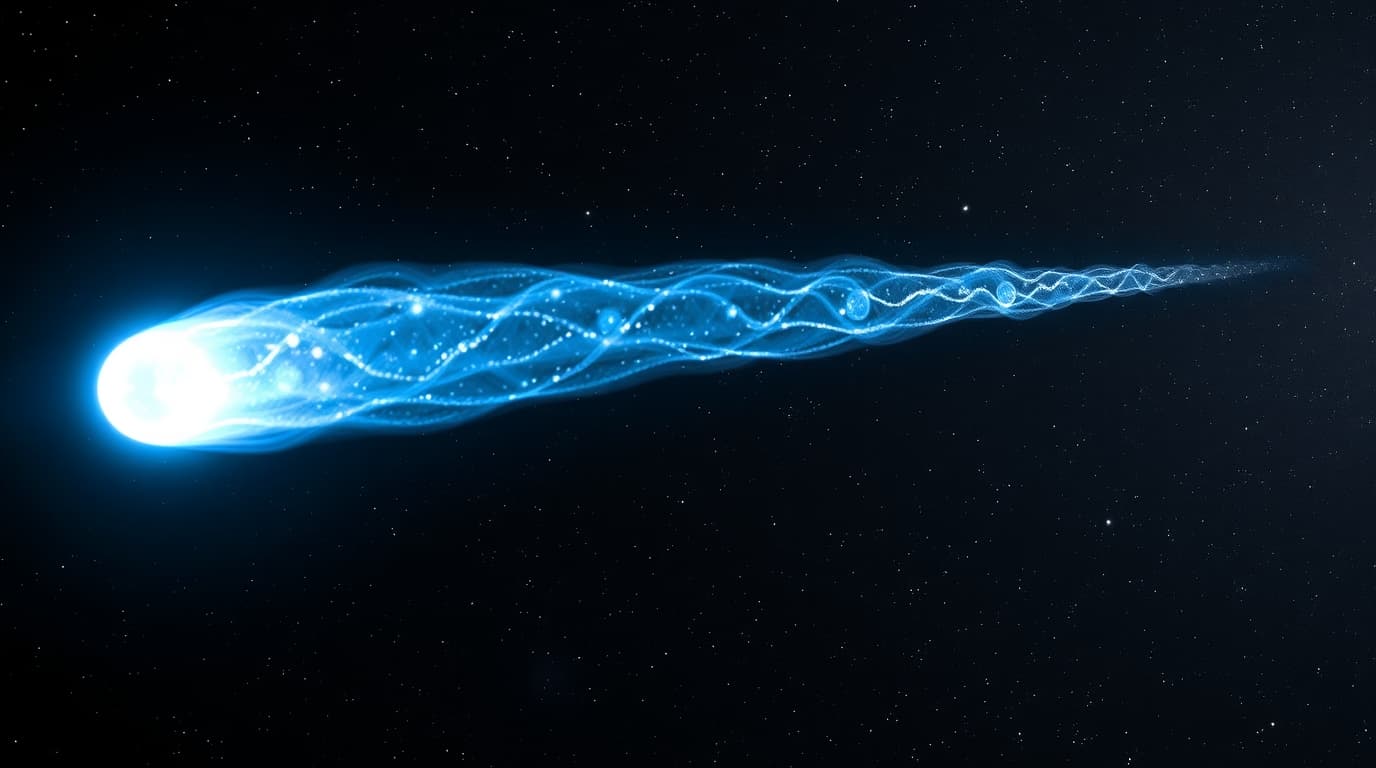
Illustration: artistic rendering of the interstellar comet 3I/ATLAS passing through the inner Solar System.
How 3I/ATLAS was discovered
3I/ATLAS was first recorded on 1 July 2025 in images taken by the Asteroid Terrestrial-impact Last Alert System (ATLAS) telescope in Chile.
Very quickly it became clear that:
- it comes from the direction of the constellation Sagittarius,
- it moves at about 58 km/s relative to the Sun,
- it follows a hyperbolic orbit – so it is not gravitationally bound to the Solar System.
Because of that orbit it received the designation 3I (“third interstellar object”), and the suffix ATLAS from the project that first detected it.
What is really strange about 3I/ATLAS?
Not everything weird is automatically an “alien weapon”, but 3I/ATLAS objectively has several features that set it apart from “standard” comets.
1. Older than the Solar System?
Analyses suggest that 3I/ATLAS likely formed in another planetary system more than 7 billion years ago, which makes it older than our Sun.
That makes it a cosmic fossil – a capsule preserving the chemical fingerprint of a long–dead system.
2. Completely “skewed” chemistry – CO₂ instead of water
Comets we know in our system are usually water ice + a bit of CO₂ and CO.
In 3I/ATLAS, the James Webb Space Telescope (JWST) saw something quite different.
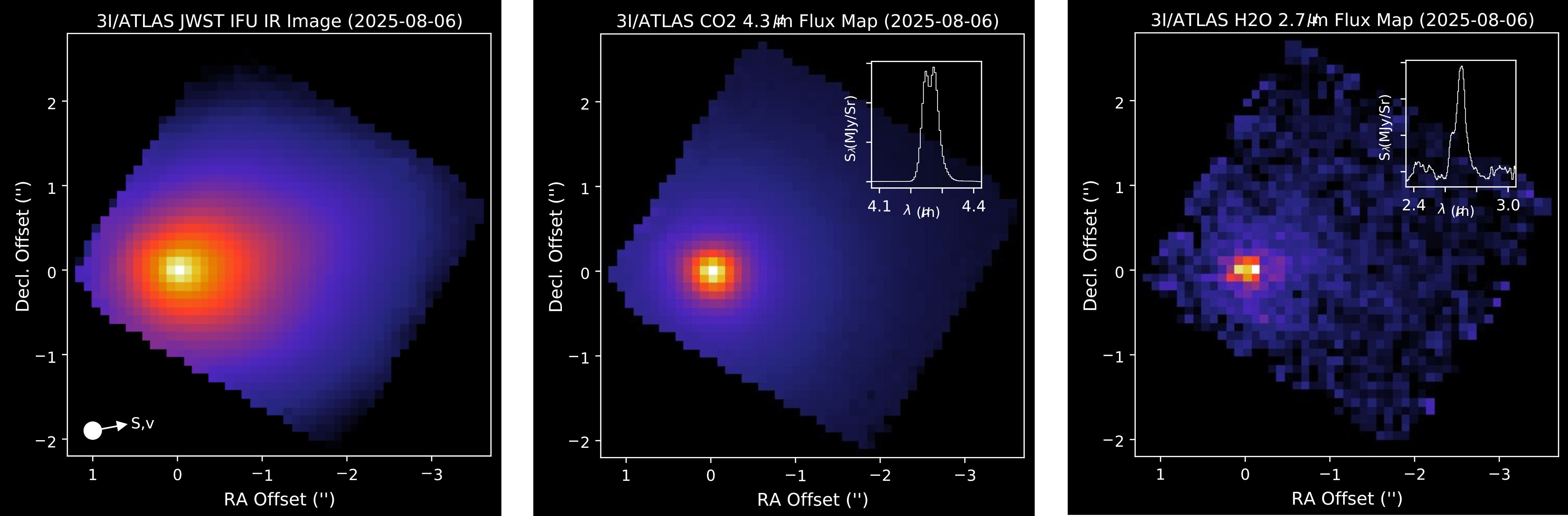
Image: JWST/NIRSpec maps of reflected light from dust (left), CO₂ emission (center) and H₂O (right) in the coma of 3I/ATLAS. Credit: NASA / CUA / M. Cordiner et al.
Spectroscopic measurements show that the coma is extremely rich in CO₂ gas:
the CO₂ / H₂O ≈ 8 ratio is among the highest ever measured for a comet.
That suggests that it:
- either formed in a region of its home system where CO₂ ice condenses easily,
- or spent billions of years exposed to much stronger radiation than our comets, so water was “burned off” faster than CO₂.
On top of that, CO, OCS, water ice and dust have been detected as well – but in ratios quite different from what we’re used to.
3. Asymmetric coma and “weird tail”
JWST and other telescopes show that:
- the coma is not symmetric around the nucleus,
- activity is enhanced on the Sun–facing side,
- at times the comet appears to have a tail that doesn’t point in the “classic” direction.
For astrophysicists this is mostly a sign of uneven outgassing of gas and dust from the surface – one side of the nucleus is shedding much more material than the other.
4. Slight “non–gravitational” acceleration
Orbit specialists have also detected tiny deviations from the path the comet would follow under gravity alone.
This has been seen in other comets too: as gas escapes from the nucleus, it pushes the body in the opposite direction – like a small rocket engine.
- Mainstream explanation: ordinary non–gravitational force from outgassing.
- Speculative reading: some authors (like Avi Loeb) remind us that a similar effect was seen with ‘Oumuamua and ask whether such behaviour could, in principle, hide a controlled propulsion system.
So far, the data does not require any exotic explanation – but it certainly keeps the imagination awake.
5. Changes in colour and brightness
Observations from Earth show that the colour and brightness of 3I/ATLAS change over time more than in a typical comet. Most likely that’s because different layers of ice (CO₂, CO, H₂O) sublimate at different distances from the Sun.
Scientists between excitement and theories
Official view: unusual, but still a comet
Most researchers see 3I/ATLAS as a very exotic, but still natural comet:
- its chemistry is extreme, but still within what models allow for other protoplanetary disks,
- non–gravitational accelerations are small and expected for an active comet,
- JWST and other telescopes clearly pick up gas and dust feeding its coma.
For them, 3I/ATLAS is above all a fantastic natural laboratory: a chunk of ice from another system, older than our Sun.
“Maybe it’s hollow… maybe it’s a probe?”
At the same time, there is a minority of voices not fully satisfied with the standard explanations.
Astrophysicist Avi Loeb, already known for suggesting that ‘Oumuamua might be artificial, argues that:
- the combination of unusual orbit,
- non–standard chemistry,
- and its dynamic behaviour
leaves room for a “technological” interpretation – e.g. a hollow object, a probe, or a fragment of a larger structure.
For now, however, there are no direct signs of an artificial origin – only a list of oddities that can (so far) be explained by natural processes. Most of the scientific community remains sceptical and stresses: extraordinary claims require extraordinary evidence.
Where are the “real” images – and why did Congress ask NASA?
Pouring oil on the fire, NASA did not immediately publish every image of 3I/ATLAS, especially those taken when the object passed near Mars and orbiters had a good view.
- A US congresswoman (Anna Paulina Luna) officially asked NASA to release the images and data at full resolution, precisely because public speculation was ramping up.
- NASA, for its part, points out that it has already released plenty of information (orbital solutions, Hubble images, JWST results), but that detailed data go through the usual calibration and scientific analysis before being made public.
The result: from the public’s perspective, a feeling that NASA is “silent”, and more room for wild stories on social media.
What if it’s “just a comet”?
Even if 3I/ATLAS turns out to be “just” a natural comet, it is still a huge deal:
- we get a chance to study a block of ice from another system,
- we can compare its chemistry with comets in our own system,
- that helps us understand how similar (or different) other planetary systems may be.
In other words, 3I/ATLAS is a test for our theories about planet formation and protoplanetary disk chemistry.
And what if it isn’t?
If one day it turns out that one of these objects really is artificial, that would probably be the most important scientific discovery in human history.
For now, however:
- we have no signals,
- we see no structures that are clearly “machine–like”,
- there is nothing that passes strict scientific scrutiny as solid evidence of technology.
So it’s healthy to keep two thoughts in your head at the same time:
- be open to the unexpected,
- but demand solid proof before jumping from “this is weird” to “this is an alien probe”.
How you can follow 3I/ATLAS yourself
If you want to track where 3I/ATLAS is right now:
- use interactive tools like NASA Eyes on the Solar System or websites like TheSkyLive,
- local astronomy forums often share ephemerides and finder charts, especially when the object is above the horizon.
For amateurs with larger telescopes it’s a challenging, but fascinating target.
Conclusion: the question is not just what 3I/ATLAS is, but what we do with it
3I/ATLAS forces us to combine:
- science (precise measurements, models),
- imagination (what if we’re not alone?),
- critical thinking (how far can we go without evidence).
It might be “just” a very old and oddly composed lump of ice from another system.
It might carry the imprint of conditions in a stellar environment that died long ago.
Either way, the best answer is: read the papers, look at the data, and only then build theories – not the other way around.