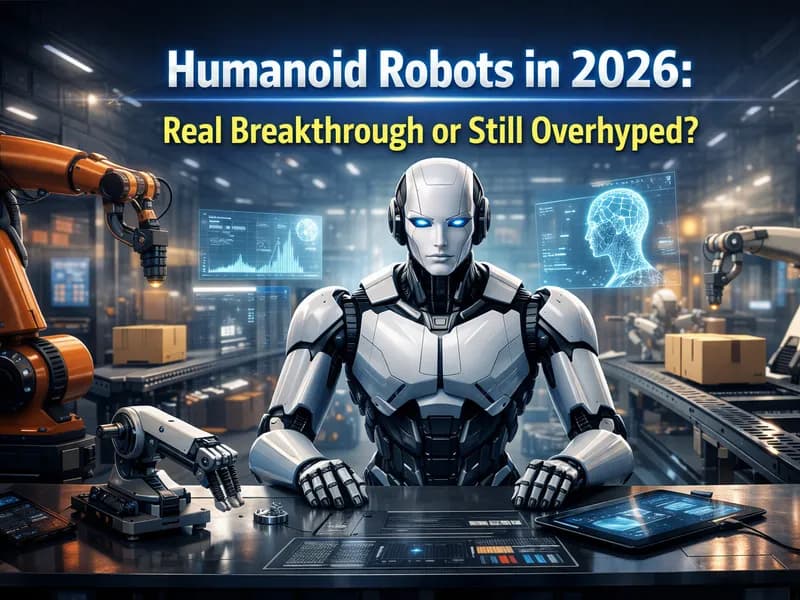
2025 – the year of humanoids: a robot that walked 106 km and the first home robots
If anyone still doubted that humanoid robots would remain forever stuck in the lab, 2025 is the year that changes the story.
Chinese robot Agibot A2 has entered the Guinness World Records by walking more than 106 kilometers fully autonomously, from Suzhou to Shanghai’s Bund. Those three days and nights of walking were not just a PR stunt – they were a demonstration that humanoid walking, balance and endurance have reached a level where factories, logistics centers and cities are starting to take them seriously.
At the same time, the first robots aimed not at industry but at our homes are arriving in the US. Figure 03 and NEO promise to fold laundry, load the dishwasher, wipe the floor and help with everyday chores. For now they are expensive and reserved for early adopters, but the message is clear: a humanoid doing household tasks is no longer science fiction – it is a product you can actually order.
Agibot A2: a 106-kilometre marathon
Agibot A2 is a humanoid robot from Chinese company AgiBot, roughly the height of an average person. In November 2025 it was given a task that would be too much even for many humans: to walk more than 106 kilometers from the city of Suzhou to the historic Shanghai Bund – without shutting down and without “walking on a cable”.
During roughly three days of continuous walking, the robot:
- traversed asphalt, sidewalks, bridges, ramps and tactile paving,
- followed traffic rules and road signs,
- maintained balance on different surfaces and slopes,
- stayed active thanks to a hot-swappable battery system, which allowed the team to change batteries without turning the robot off.
The result is a Guinness World Record for the longest distance walked continuously by a humanoid robot – and a clear signal to industry that the combination of hardware, balance algorithms and energy management is entering a mature phase.
In practice, this marathon is a stress test for what such robots are expected to do tomorrow: long shifts in factories and warehouses, or working as mobile assistants in large complexes such as hospitals, campuses, airports and smart cities.
Why China is pushing humanoids so hard
The Agibot A2 record is not an isolated event – it is part of a broader Chinese strategy.
In recent years China has:
- adopted national plans for robotics development through the end of the decade,
- launched huge funding programs (hundreds of billions of dollars) for AI and robotics,
- rolled out pilot projects that bring humanoids into factories, warehouses and the public sector.
Analysts estimate that the global humanoid robot market could be worth trillions of dollars over the coming decades, and China clearly wants a very large slice of that pie. That means more pilots in the real world, more mass production and more robots that people actually see on streets and in industrial halls – not just on conference stages.
For the rest of the world, the message is twofold:
- Walking and balance technology for humanoids is maturing quickly – it is no longer just a YouTube demo on a flat lab floor.
- Scale is becoming decisive – whoever achieves mass production and lower unit costs first will have a huge advantage in industry and smart-city deployments.
Home robots: Figure 03 and NEO
While Agibot A2 showcases endurance outdoors, the first humanoids designed to work inside the home are emerging in the US.
Figure 03
US company Figure AI is developing Figure 03, a humanoid robot envisioned as a general-purpose home assistant. Its key ideas:
- folding laundry, loading the dishwasher, tidying up rooms, moving objects,
- a proprietary AI system (Helix) that learns the layout of each home,
- voice communication – the user simply says what needs to be done using natural language.
Figure 03 is still in early development, but it shows where home humanoids are heading: from single-purpose devices (vacuum robots, mops) towards universal helpers that can be taught new tasks over time.
NEO
Norwegian–American company 1X is developing humanoid NEO as a “consumer-ready” home robot:
- focused on everyday tasks such as laundry, tidying, bringing objects and basic cleaning,
- powered by an embedded large language model for conversation and task understanding,
- can be remotely supervised and trained by experts, who can teach it new skills,
- planned to launch first in the US, with a price and subscription model comparable to an expensive car.
NEO is essentially the first humanoid that an average reader can look at and say: “OK, this is way too expensive for me, but someone out there can realistically buy this for their home.” That is a huge psychological shift compared to the years when humanoids were exclusively lab prototypes or industrial demonstrators.
How close are we to a robot in every home?
Despite all the impressive footage, it is worth taking a realistic look at where we actually are:
- Walking and basic manipulation (grasping, carrying, pushing) are good enough for pilot projects in industry and logistics.
- Home humanoids are just entering the market and will initially be available only to wealthier early adopters and specific use cases (elderly care with human supervision, high-end households, tech enthusiasts).
- Price remains the biggest barrier to mass adoption: these robots cost as much as a higher-end car or require a serious monthly subscription.
- Security and privacy are open questions – systems like NEO rely on cameras, microphones and cloud AI, and in some cases on remote experts who can see what the robot sees.
A realistic timeline might look like this:
- 2025–2027 – more humanoids in factories and warehouses; first models in the homes of enthusiasts and pilot users.
- 2028–2032 – falling prices and a wider range of offerings; “robot as a service” for home help and elder care.
- After 2032 – a humanoid in the home is no longer exotic but a real option for a share of households, much like robot vacuum cleaners and smart speakers today.
Conclusion
Agibot A2’s 106-kilometre walk and the arrival of early home models like Figure 03 and NEO show that the era of humanoid robots is truly beginning. We are not yet at the point where everyone has a personal android, but the question has quietly changed from “if they will exist” to “when and for what we will actually need our first humanoid.”
For industry, this means a new class of workforce – robots that can operate in spaces designed for humans, using existing tools and infrastructure. For everyday users, it means that the idea of a robot in the home is moving from science-fiction movies into long-term planning for the next decade.
On the InfoHelm Tech portal, we will keep following this race – from factories and city streets to the moment when having a humanoid robot at home becomes as normal as having a smartphone in your pocket.
Disclaimer: This article is for informational purposes only and does not constitute financial, investment, legal or any other form of professional advice.