AI – something new or a fifty-year-old technology?
Suddenly everyone is talking about AI.
On front pages, in phone commercials, in writing tools, in photo apps… If we believed the media, artificial intelligence “came out of nowhere” around 2022/2023.
But if we scratch the surface a bit, one uncomfortable question appears:
Is AI really a brand-new thing – or a technology that has been here for 50+ years, only now released “to ordinary people”?
Why does it look like AI exploded “overnight”?
In just a few years, the number of people using generative AI tools jumped from a niche of geeks to hundreds of millions of users. The chart makes it obvious:
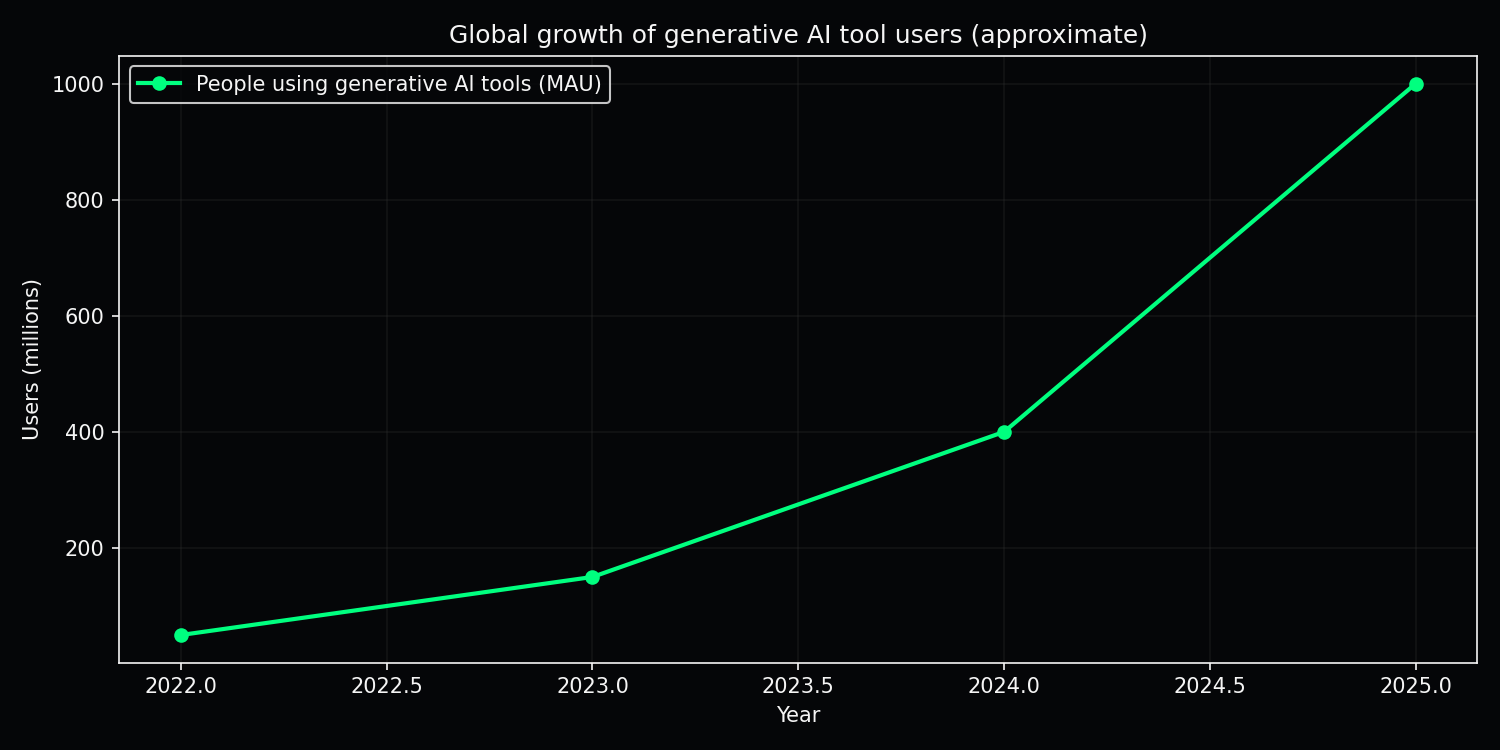
Chart: approximate growth of monthly active users of generative AI tools – from tens of millions to around a billion users between 2022 and 2025.
From an average user’s point of view, the story looks like this:
- yesterday nothing existed,
- today we have ChatGPT, image generators, music, code, video,
- tomorrow – who knows, maybe fully autonomous systems.
However, under the surface this “explosion” is the result of a long development history plus a few key technological and business turning points.
A short history of artificial intelligence (without textbooks)
1950s: Turing and the question “can machines think?”
Back in 1950 Alan Turing asks the famous question:
“Can machines think?” and proposes the Turing test as a practical criterion.
The idea of artificial intelligence is more philosophical than practical at that time – but the seed is planted.
1960s and 1970s: symbolic AI and expert systems
In the following decades, so-called symbolic AI dominates:
- “if–then” rules,
- logical systems,
- early expert systems helping, for example, doctors with diagnosis.
Computers are slow, data is limited, but ambition is huge:
encode knowledge directly into the system via rules.
1980s: neural networks and backpropagation
In the 1980s interest in neural networks returns – mathematical models inspired by neurons in the brain.
The key moment: the backpropagation method, which allows networks to be trained more efficiently.
Still, we’re missing:
- powerful enough processors,
- huge datasets,
- and “cheap” computing infrastructure.
1990s and 2000s: data mining and early machine learning
With the growth of the internet and databases, the focus shifts to:
- data mining – digging through large datasets,
- classification, regression, recommendations,
- early machine learning algorithms (SVM, random forest, boosting…).
AI is already quietly working in the background:
in search engines, movie recommendations, spam filters, credit scoring systems.
AI in the military and “secret” projects
The technologies we now call AI have long been used behind closed doors:
- radar and sonar systems,
- satellite image analysis,
- automatic signal recognition and cryptography,
- early forms of speech and image recognition.
The logic is simple:
- if a technology gives a strategic advantage,
- the military and intelligence agencies will use it first,
- only then does it reach the civilian sector.
That doesn’t mean there is one “secret mega-mind”, but it’s realistic to assume that:
- experiments with autonomous drones,
- systems for mass data analytics,
- and advanced predictive models
started long before we saw the first public chatbots.
Why did the “explosion” happen only now?
Three main reasons why we got massive, visible AI only in the 2020s:
1. The GPU revolution
Graphics cards (GPUs) built for gaming turned out to be perfect for:
- parallel computation,
- training large neural networks.
With the arrival of cloud platforms (AWS, GCP, Azure) access to that power became rentable – you don’t need your own data center anymore.
2. Big data – the internet as a huge dataset
The internet has provided:
- billions of sentences of text,
- billions of images, videos, code snippets,
- endless logs of user behaviour.
Modern models are trained exactly on those datasets.
3. The business model
Only now is there a clear business incentive:
- automating support and operations,
- speeding up development,
- a new generation of SaaS tools,
- a race between Big Tech players for market share.
The result: AI is no longer hiding “behind the scenes” – it’s being pushed straight into users’ hands.
How today’s generative models differ from “old” AI
These days we mostly talk about generative AI – models that write text, draw images, compose music and write code.
At a high level, the difference looks like this:
- Expert systems (old AI) – hand-coded rules, “if–then” logic, narrow domains.
- LLMs and deep learning (new AI) – learn from massive amounts of data, spotting statistical patterns.
One way to visualize where users are today is by types of AI tools they use:
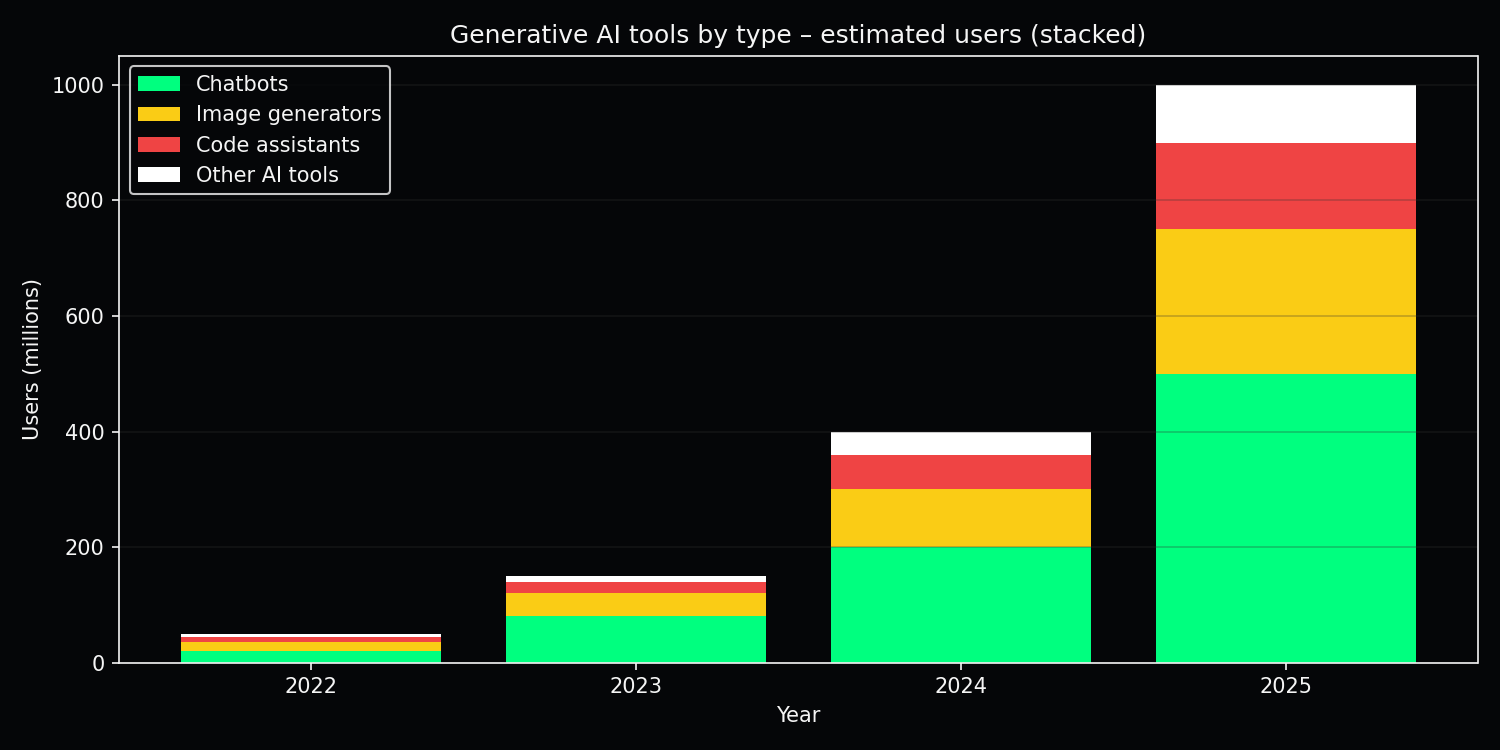
Chart: approximate distribution of users of generative AI tools by category – chatbots, image generators, code assistants and other AI tools.
“Parrots” that still get the job done
It’s often said that LLMs are just “sophisticated parrots”:
- they don’t understand the world like humans do,
- they predict the next word based on probability.
But in practice:
- that “parrot” can summarise hundreds of pages,
- structure information,
- write a first draft of a text, code or report.
In other words: it may not be a conscious being, but it is a very useful tool.
What probably already exists behind the scenes
If models this powerful are available publicly, it’s reasonable to assume that:
- there are larger, specialised versions for analytics,
- AI is already widely used in intelligence analysis, financial markets, cyber security,
- more autonomous systems are being tested than we currently see in civilian apps.
The historical pattern is similar:
- technology is born in labs and special projects,
- it is used quietly in the background,
- only then does it reach the consumer level as a “new thing”.
Risks and opportunities
What can be good?
The positive side is significant:
- Medicine – faster image analysis, personalised therapy, pattern detection in medical data.
- Science – generating hypotheses, analysing complex systems, accelerating research.
- Creativity – tools for music, images, video, writing; a single person with a laptop gains the power of a small studio.
What can go wrong?
Serious risks also exist:
- Deepfakes and manipulation – it becomes harder and harder to distinguish truth from simulation.
- Surveillance – combining cameras, face recognition and analytics creates new forms of tracking.
- Job automation – jobs don’t “disappear overnight”, but they are reshaped, often faster than education systems can adapt.
Three short scenarios
- Optimistic – AI becomes a “co-pilot” at work and in everyday life; productivity rises, new kinds of jobs appear, medical research accelerates.
- Pessimistic – surveillance, manipulation, concentration of power in the hands of a few corporations and states; social inequalities deepen.
- Realistic mix – we get both; AI becomes a mirror of humanity: it amplifies both the good and the bad tendencies.
Conclusion: AI as a mirror, not magic
Artificial intelligence is not magic that “fell from the sky” in 2022.
It is the result of decades of work on mathematics, electronics, software – and human ambition.
AI doesn’t just change technology; it speeds up what people already are: creativity and greed, empathy and manipulation.
That’s why the most important question for the next 10–20 years is less technical and more human:
- not just “what can AI do”,
- but “what do we want to do with AI”.
Hype and fear come and go, but responsibility stays – with us.