Investment gold: how it went from $1,000 to $4,000 per ounce in 10 years
While the crypto market keeps swinging in its usual cycles, gold quietly delivered one of the strongest bull runs in modern history. In 2025 the gold price broke above $4,000 per ounce and then printed new all-time highs.
If we zoom out 10 years, the story looks even more impressive: over the last decade gold moved from around $1,000–1,100 per ounce to more than $4,000, for a total gain on the order of 200–300%. That makes it one of the more reliable long-term hedge assets in portfolios worldwide – and raises the classic question: is it too late to get in, or is a new phase just starting?
This article is for readers who see investment gold (bars, coins, ETFs) as a conservative addition to a portfolio – alongside crypto, classic savings and mutual funds.
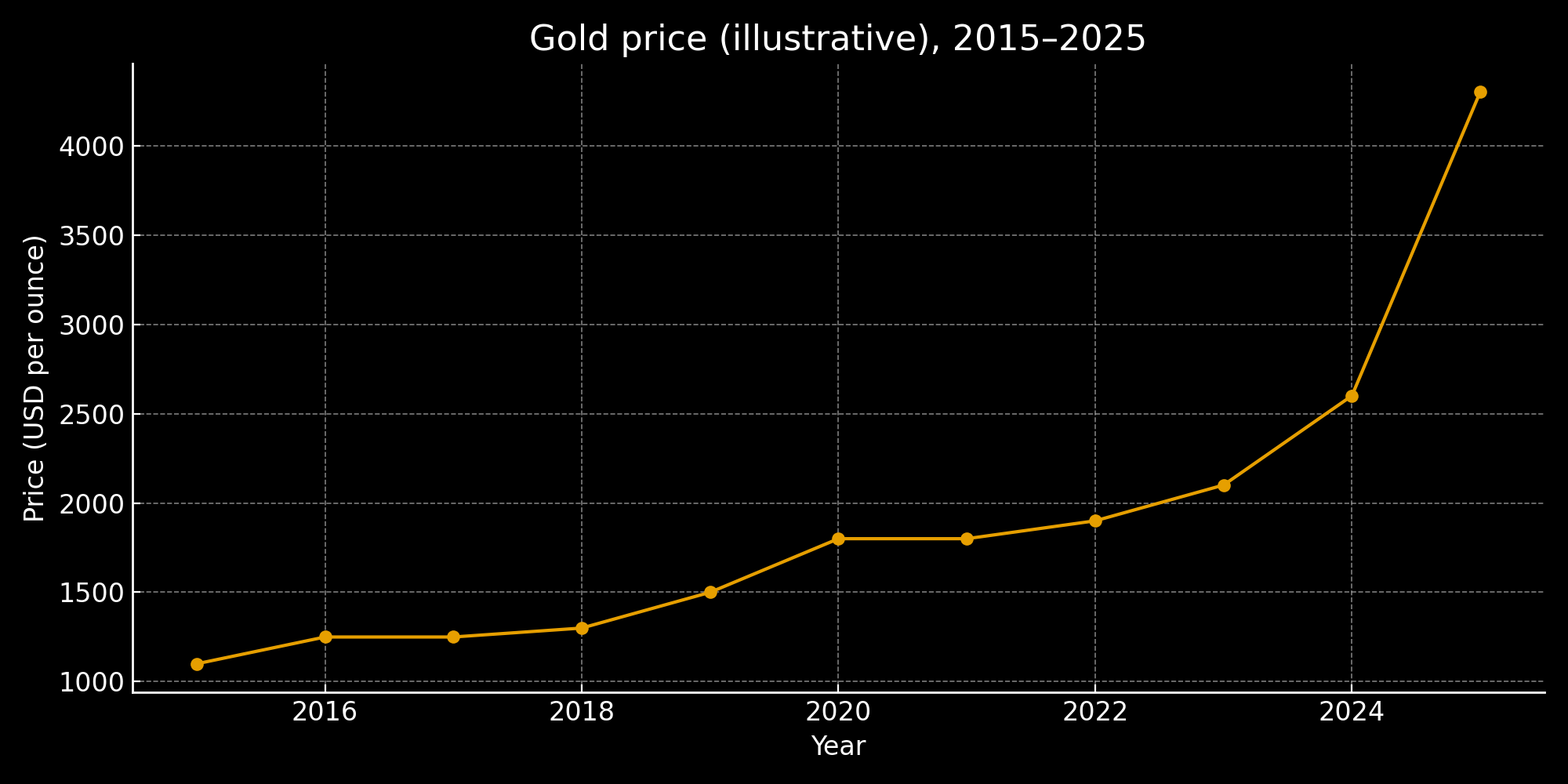
💡 Note: the chart above shows an approximate 10-year price trend with rounded values. It’s not a precise historical price series, but an illustration of the overall move.
Gold at all-time highs: where we are now
In the last few years gold has broken out of a long “sideways” phase and moved into a new price regime:
- the $2,000/oz level was broken and then held across several cycles
- during 2024 and 2025 we saw multiple new all-time highs
- in a short time price moved from roughly $2,000–2,500 into the $3,000 zone and then above $4,000 per ounce
Behind this move is a combination of factors:
- central banks aggressively increasing gold reserves
- investors searching for a “safe haven” amid geopolitical tensions and recession risk
- expectations that major central banks (Fed, ECB…) will gradually pivot away from ultra-tight monetary policy
In other words: gold is currently playing a double role – a system-risk hedge and a monetary anchor in a world where trust in fiat currencies looks increasingly fragile.
How gold climbed over the last 10 years (2015–2025)
If we zoom out over the last decade, the rough shape of the curve looks like this:
- 2015–2018: trading mostly between $1,050 and $1,300 – gold is “boring” but stable
- 2019–2020: global tensions and the pandemic push prices into the $1,500–2,000 zone
- 2021–2022: consolidation phase – gold fluctuates, mostly below or around $2,000, while the focus shifts to rising rates and a stronger dollar
- 2023–2024: central bank buying accelerates, inflation stays elevated, gold breaks above prior all-time highs and holds above $2,000+
- 2025: a “super-rally” – psychological levels at $3,000 and $4,000 are taken out, so in 10 years gold has roughly tripled in USD terms
For an investor who bought physical investment gold (bars, coins) ten years ago, this decade brought:
- a solid real return even after inflation
- less stress than with equities or crypto
- renewed proof that gold still works as a long-term store of value in times of crisis
Of course, as with any asset that has already moved a lot, the key question is what happens after such a strong run.
Why gold is back in the spotlight
There are a few key reasons why gold may be more important today than it was 10–15 years ago.
1. Uncertainty + crisis = gold
Historically, when uncertainty spikes, gold tends to do well. The pattern repeats:
- geopolitical crises
- trade wars and sanctions
- potential recessions and sudden shifts in monetary policy
In this environment, investors – especially large funds and central banks – tend to increase their gold allocation to cushion shocks in equities, bonds and currencies.
2. Central banks are voting… with gold
In recent years central banks have been buying gold at or near record levels, and their share of total gold demand keeps rising.
That’s a very concrete signal:
- countries looking to reduce reliance on the US dollar are building up gold reserves
- gold is treated as a strategic reserve asset, not just another investment product
3. Real interest rates and the dollar
Even when nominal interest rates are elevated, markets look ahead – towards a potential cycle of rate cuts and a weaker dollar. Gold traditionally performs well in those shifts, because its value is not based on yield, but on trust and scarcity.
What analysts expect for the next few years
Forecasts vary, but most large institutions still lean bullish, with an explicit warning that pullbacks are normal:
- some analysts expect gold to hold above $3,000 as the new “floor”
- more optimistic scenarios talk about a range of $4,000–5,000 over the next couple of years
- more conservative outlooks see gold spiking in periods of stress, but correcting during calmer market phases
Reality will likely land somewhere in between:
gold is in a strong multi-year uptrend, but no asset moves in a straight line – 15–30% corrections are perfectly realistic even in a bull scenario.
What counts as “investment gold”?
When we say investment gold, in practice we usually mean:
1. Physical gold
- bars (1g, 5g, 10g, 50g, 100g, 1oz…)
- investment coins
Pros: no issuer risk – you don’t own a promise, you own metal.
Cons: storage and insurance costs, plus spreads when buying/selling.
2. ETFs and “paper gold”
- exchange-traded funds that track the gold price (with physical backing or via derivatives)
- easy to buy and sell through a broker, great for portfolio rebalancing
- but they carry regulatory, broker and fund-structure risk
3. Gold miners and gold funds
- a “leveraged” exposure – they often rise more than gold in good times
- but fall more sharply in bad times, and add business risks (mining costs, permits, regulation…)
4. Tokenized gold / crypto solutions
- crypto tokens that claim to be backed by physical gold
- can be interesting to advanced users
- require extra due diligence on the issuer and custodian
Gold and crypto: rivals or on the same team?
Within the InfoHelm ecosystem gold fits naturally into “crypto & economy”, because it’s so often mentioned in the same breath as Bitcoin:
- both are seen as “hard assets” outside the traditional financial system
- both react to inflation, monetary experiments and declining trust in fiat
- but they behave very differently in terms of volatility, liquidity and regulation
Very simplified:
- gold is a slow, heavy but reliable tanker
- Bitcoin (and crypto in general) is a fast, hyper-volatile speedboat
For many investors, a mix of “gold + a bit of crypto” is becoming a way to balance a stable hedge with a higher-risk, high-upside component.
Conclusion: does it make sense to get in now?
Looking only at the chart, it’s easy to fall into the trap:
“If I had bought 10 years ago… I’d be up huge today.”
The problem is that investment decisions are made today, not in hindsight.
A few practical points to think about:
- gold is in a strong multi-year trend
- most big institutions see room for further upside, but also for serious corrections
- for small investors, gold is usually a portfolio add-on, not a replacement for savings accounts, real estate, pensions or an entire crypto stack
- the answer to “does it make sense now?” depends on:
- your time horizon (years vs decades)
- how you handle drawdowns
- your overall portfolio and goals
If you decide to explore investment gold, a common-sense approach is:
- start with a small share of your total net worth
- clearly separate the “safety” part of your portfolio from the speculative part
- think in years and decades, not days and weeks
Disclaimer: This article is for informational purposes only and does not constitute financial, investment, legal or any other form of professional advice.
Before making any investment decision, consult a licensed advisor and make choices in line with your own risk profile.