Best AI Tools for YouTube Creators in 2026
YouTube is no longer a platform where it is enough to simply record a good video. Creators now have to think about titles, thumbnails, short clips for Shorts, subtitles, audio quality, editing pace, and distribution across multiple platforms. That is exactly why AI tools are becoming one of the most important levers for channel growth.
The good news is that you no longer need a full team to make a channel look professional. With the right tools, a single creator can generate ideas, speed up editing, automatically turn long videos into Shorts, improve audio, and even localize content for new audiences. The real value of AI is not replacing the creator, but removing repetitive and time-consuming steps.
Below are the tools that make the most sense in today’s YouTube workflow, especially for solo creators, small teams, and channels that want to publish more often without sacrificing quality.
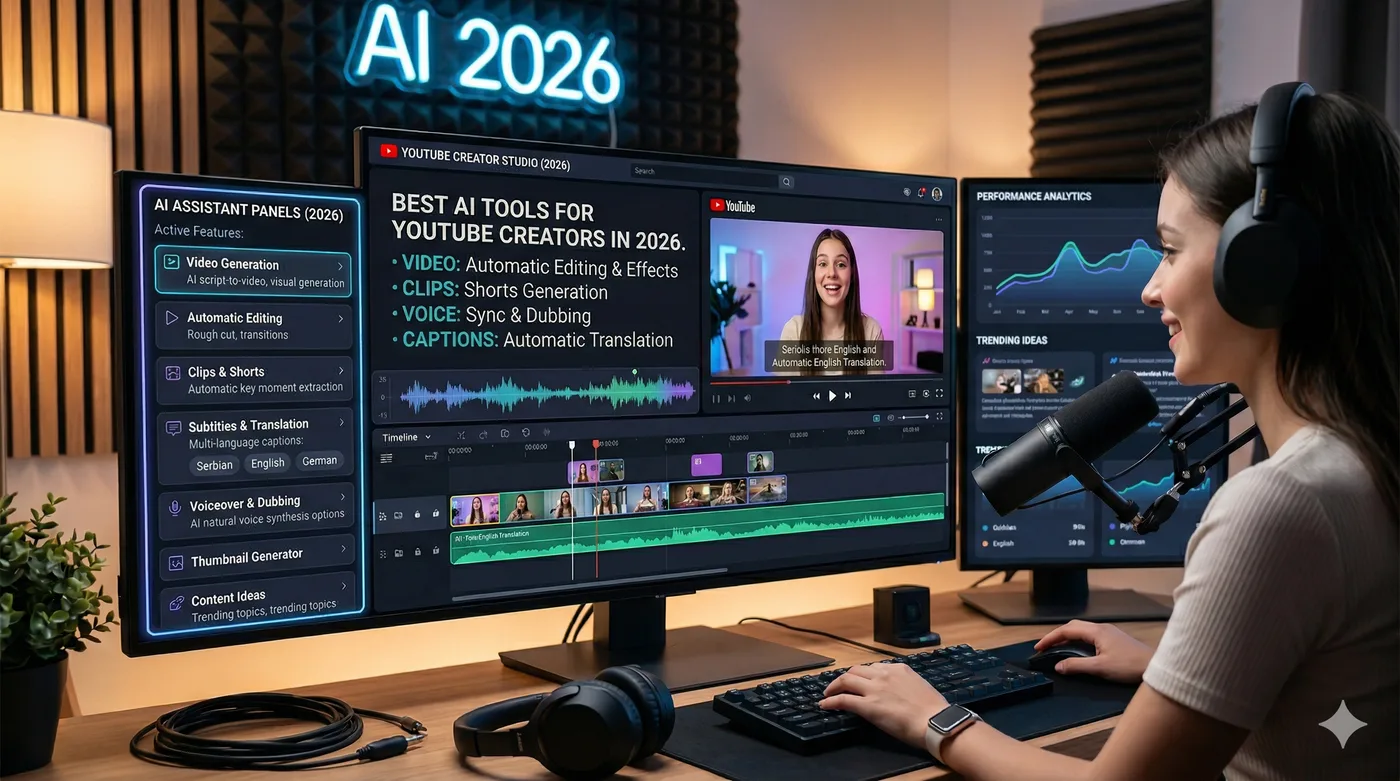
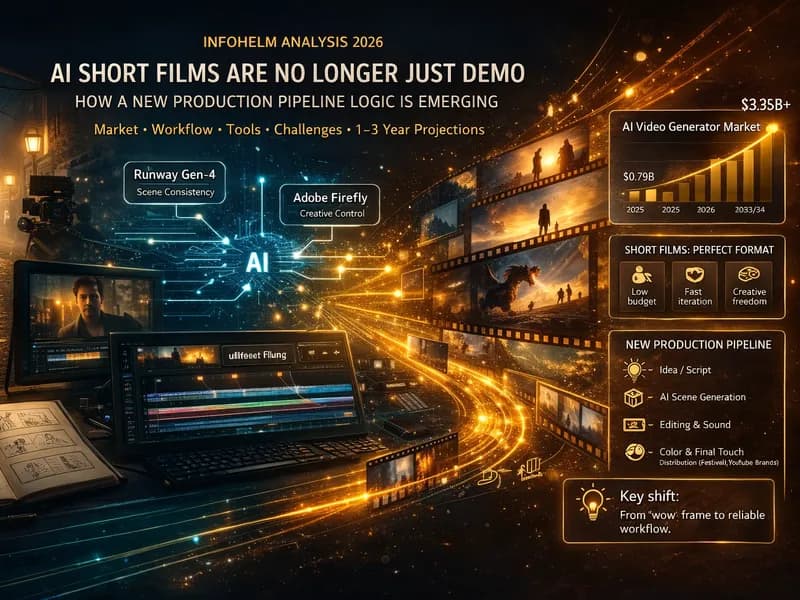
Visual illustration: InfoHelm
The AI tools that save the most time today
Among editing and spoken-content tools, Descript still stands out as one of the most practical choices. Its biggest advantage is that you can edit video and audio through the transcript itself, which is especially useful for interviews, tutorials, podcasts, and face-cam formats. For creators who regularly cut long conversations or remove filler words, it remains one of the fastest ways to work.
For turning long-form videos into short clips, OpusClip is one of the most interesting options. Tools like this have become important because a podcast, interview, or analysis video rarely stays as just one YouTube upload anymore. The same source material is now expected to generate multiple Shorts, and AI that can automatically identify the most engaging moments can dramatically speed up production.
When it comes to generating or transforming video material, Runway is often seen as a creative extension of traditional editing. It may not be the first choice for every YouTuber, but it can be extremely useful for intros, B-roll, stylized insert shots, visual experiments, and productions that want to look more expensive than they actually are.
For voice, narration, and content localization, ElevenLabs is becoming increasingly important. YouTube channels are no longer thinking in terms of one language and one audience only. If a creator wants to test international markets, voice dubbing, AI voiceover, and audio enhancement are no longer luxuries, but realistic tools for expanding reach.
In the area of ideation, title optimization, and understanding YouTube search behavior, vidIQ remains highly relevant. For many small channels, the problem is not video quality, but topic selection and packaging. AI tools that help with keyword research, titles, descriptions, and content planning often deliver more impact than expensive production without a clear direction.
A similar role, but with a stronger focus on optimizing existing content, is played by TubeBuddy. It is especially useful for creators who want to test thumbnails, titles, and CTR strategies without relying entirely on guesswork. On YouTube, it is often not just the better video that wins, but the better-packaged one, and that is exactly where tools like this can make a direct difference.
For creators who want a simpler all-in-one approach, Canva is increasingly crossing the line between a design tool and a real AI content assistant. Thumbnails, community post visuals, short promo clips, and simple video edits can all be handled without complex software. That makes it especially useful for channels that prioritize speed and a consistent visual identity.
If the focus is on interviews, remote recording, and a fast repurposing workflow, Riverside is a very practical solution. Its combination of recording, transcription, subtitles, and clip creation works especially well for educational channels, podcasts, and any format where spoken content is central.
How to choose the right tool for your channel
The biggest mistake is looking for one tool that does everything. In practice, the best YouTube workflow usually comes from combining two or three platforms depending on the type of content you produce.
For educational channels, podcasts, and interviews, a strong combination can be Descript + Riverside + vidIQ. That gives a creator recording, transcription, faster editing, and support with topics, titles, and optimization.
For channels aiming for faster growth through Shorts and cross-platform publishing, OpusClip + Canva + TubeBuddy often makes more sense. One tool accelerates short-form clip creation, another helps package the visuals, and the third supports testing what actually gets clicks.
For creative, cinematic, or experimental channels, an interesting setup may be Runway + ElevenLabs + Canva. In that case, AI is not only about saving time, but also about expanding production capabilities that used to be reserved for larger teams.
It is also important to understand that not every AI tool is equally useful at every stage of channel growth. A small channel often gains more from better topics, stronger titles, and improved thumbnails than from the most advanced generative video platform. More complex tools for repurposing, voiceover, and automation usually become more valuable once production starts to scale.
Conclusion
The best AI tools for YouTube creators in 2026 are not necessarily the ones that do the most, but the ones that remove the biggest bottlenecks in daily production. For one creator that may be faster editing, for another it may be titles and SEO, and for someone else it may be turning one long video into ten short clips.
That is why the smartest approach is to start with a real workflow problem, not with hype. If a channel is growing slowly, better SEO and thumbnail testing may matter more. If production takes too long, editing, transcription, and repurposing should come first. And if the goal is to reach international audiences, audio tools and localization become essential.
AI is no longer just an optional add-on for YouTube creators. For many channels, it is quickly becoming a foundational part of the modern production process.
Note: This article is educational and informational.