AI Short Films Are No Longer Just Demos: How a New Production Logic Is Emerging
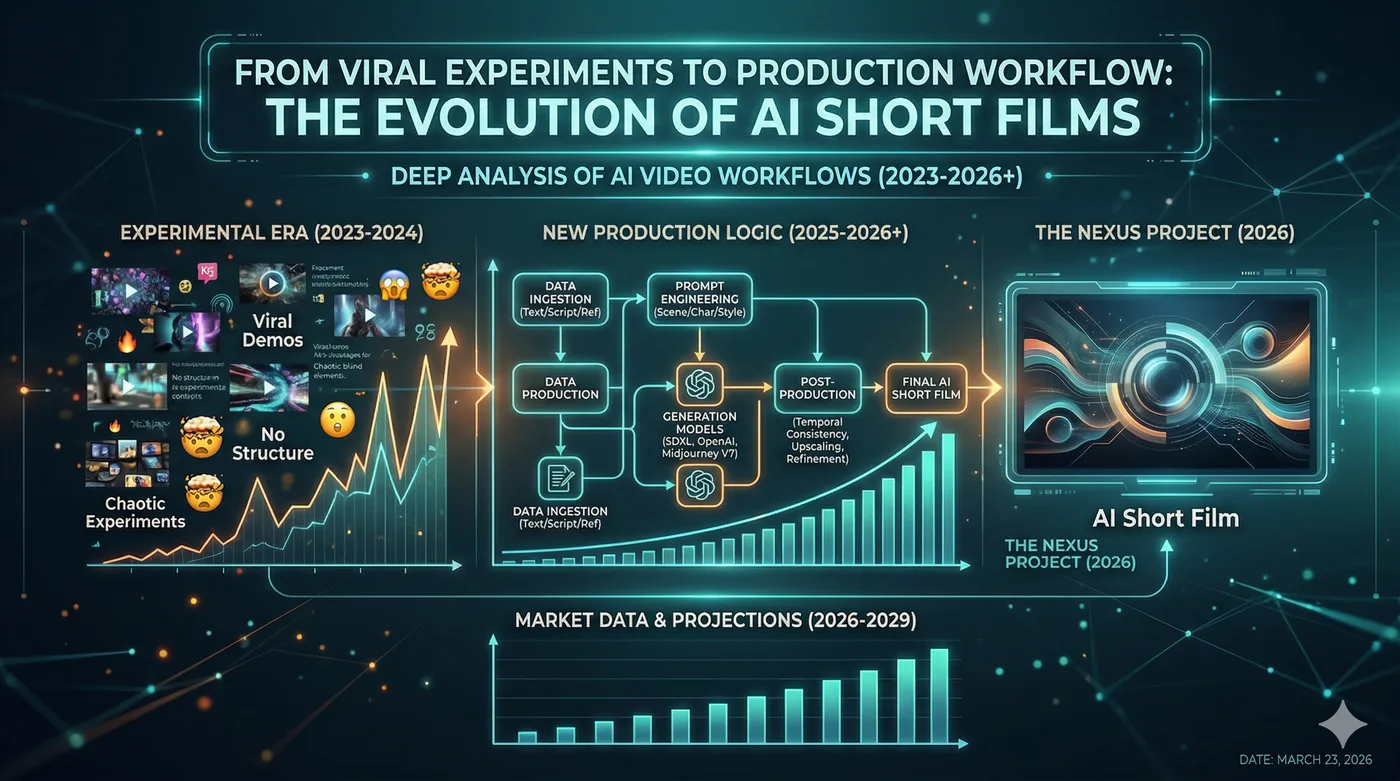
Until recently, generative video still looked mostly like a technological attraction: a few impressive seconds, strong aesthetics, plenty of hype, and very little serious production use. That picture is now changing. AI video tools are no longer judged only by whether they can generate a beautiful shot, but by whether they can enter a real creative process: scene development, iteration, continuity, shot variation, sound work, post-production, and delivery of a finished piece.
That is the key shift. While the first phase of generative video was driven by demonstrations of possibility, the new phase is driven by workflow. The central question is no longer whether AI can generate video at all, but whether it can become part of a reliable production system that saves time, lowers costs, and expands the creative reach of solo creators and small teams.
That is exactly why AI short films are becoming interesting far beyond a narrow tech audience. Short-form storytelling is a natural testing ground for new tools: it requires smaller budgets, faster iteration, less logistics, and allows more stylistic experimentation. What is happening today in AI short films could become part of the broader video industry standard tomorrow.
The core argument of this analysis is simple: AI short films will not fully replace traditional production, but they will very likely redefine who can create visually ambitious work, and at what cost. In other words, this is not just the evolution of a new tool. It is the emergence of a new production economy.
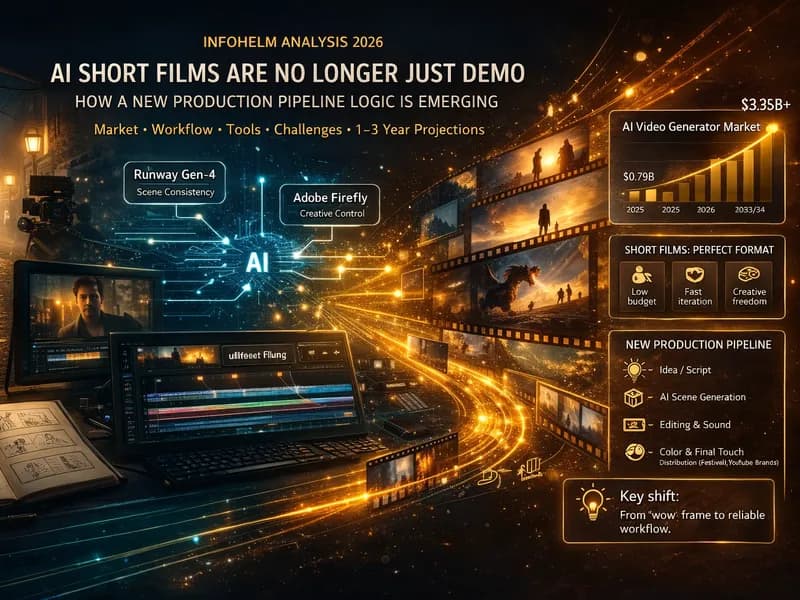
Visual illustration: InfoHelm
Executive Summary
- Generative video is entering a new phase in which workflow matters more than the original wow factor.
- AI short films make sense because they combine a low entry threshold with a high degree of stylistic freedom.
- The main bottleneck is no longer just the quality of a single shot, but continuity across scenes, character control, camera logic, and consistent post-production.
- The AI video generator market is still relatively small compared to the broader generative AI space, but it is growing fast enough to become a serious creative niche.
- The biggest winners over the next 1–3 years will probably not be “AI directors” alone, but creators who combine AI generation with editing, sound, directing logic, and distribution.
1. Context and market background
In 2026, it is no longer in doubt that AI video exists as a product category. The real question is how close it is to meaningful professional use.
Tools no longer focus only on the spectacular prompt-to-video moment. They are increasingly emphasizing control. That matters much more for cinematic language than a single beautiful generation. When a creator can repeat a character, preserve a scene’s atmosphere, and maintain continuity across shots, AI video begins to resemble part of a real production process rather than a visual trick.
At the same time, the market shows that the category is still early, but no longer marginal. AI video generators are moving out of the niche experiment phase and becoming an independent creative category with their own internal economics.
That matters especially for short films, because they are the ideal format for adopting a new technology. Feature-length films require strict continuity discipline, larger budgets, more complex legal structures, and a much higher tolerance for risk. Short films are more flexible. They are small enough to allow experimentation, but serious enough to show whether the tool actually works.
2. Data and numerical analysis
To understand where AI short films really stand, it is useful to separate three levels: the tool market, workflow maturity, and the economic logic of production.
The tool market is growing, but growth alone does not prove that the form itself has matured. That is why it matters more to look at what is changing in product capabilities: character control, scene continuity, multi-platform availability, integration with audio and design tools, and the ability for the same creator to iterate quickly through multiple versions of an idea.
The market growth figures are therefore not the conclusion, but the signal. The deeper question is where that growth connects with the real creative process.
| Category | Value | Estimate |
|---|---|---|
| AI video generator market 2025 | $716.8M–$788.5M | Early but fast-growing segment |
| AI video generator market 2026 | $847M–$946.4M | Expansion of commercial usage |
| Projection 2033/2034 | $3.35B–$3.44B | A signal of serious commercialization |
| Main bottleneck today | Continuity | Characters, locations, and scenes across multiple shots |
| Biggest economic shift | Faster iteration | Lower cost of testing an idea and a scene |
When those numbers are combined with product development, a clearer picture emerges: the market is not growing because people want one more AI effect. It is growing because tools are beginning to solve real production problems.
The biggest economic shift for short films is not necessarily full crew replacement, but the compression of pre-production and iteration. A creator or small team can now test visual tone, character design, scene look, atmosphere, storyboard rhythm, and alternate shot versions much faster.
In traditional production, this takes more time, more people, and more logistics. In an AI workflow, that stage can become dramatically faster, even when the final result still requires editing, sound design, voice work, and manual correction.
3. Visual analysis
The essence of the current shift is not that the quality of generated shots is improving in a straight line, but that the entire production curve is moving. As tools become better at continuity and control, creators gain room to think cinematically rather than purely in prompt terms.
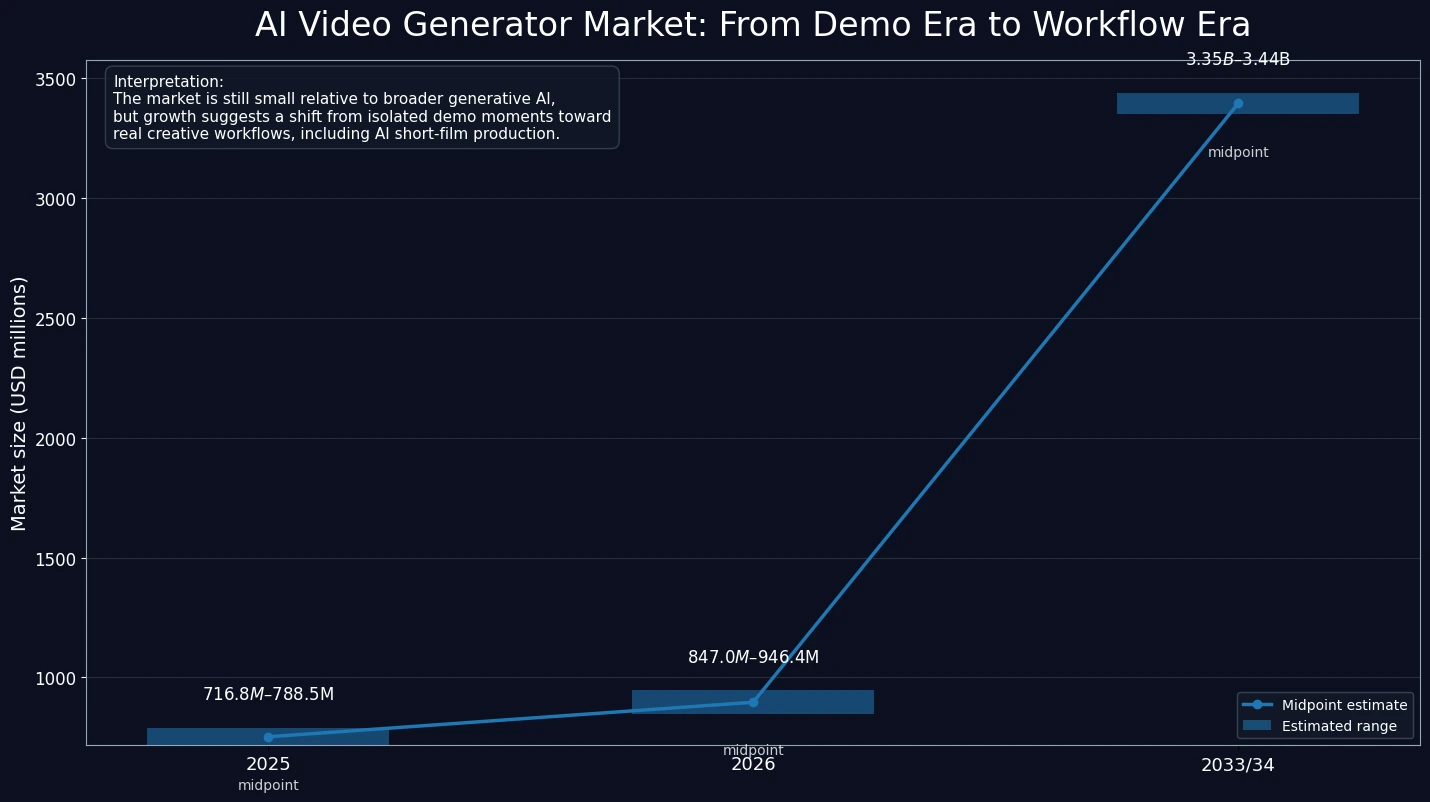
Chart: The shift from a single wow frame toward greater control, scene continuity, and real production workflow use.
Visually speaking, the market is moving through three phases.
The first phase is the demo era: focus on the isolated shot, virality, and technological shock.
The second phase is the creator workflow era: focus on Shorts, music visuals, teaser material, experimental short-form storytelling, and social video.
The third phase, which is only now beginning, is the narrative workflow era: consistent characters, directing control, modular scene design, partial sound integration, and more serious post-production.
AI short films today sit exactly between the second and third phases. They are good enough to leave the lab, but still not stable enough to carry more complex long-form narrative work without friction.
4. Structural implications
The biggest implication for companies is not that everyone will become a film studio, but that the cost of visual ambition will fall. Brands, media companies, indie creators, and small productions will gain access to visual styles that used to be expensive or logistically difficult.
For the market, that means value will lie less in a single model that does everything, and more in tools that close the workflow loop: generation, camera control, continuity, editability, audio, asset management, and collaboration.
For creators, the consequence may be even bigger. AI short films lower the technical barrier to entry, but raise the importance of directorial and editorial intelligence. Once more people gain access to strong generation tools, differentiation no longer comes from access alone. It comes from rhythm, scene structure, continuity management, editing, sound, and narrative economy.
In other words, AI will likely reduce the cost of execution, while increasing the importance of taste and working systems.
5. Forward look
Over the next 1–3 years, we will likely see three parallel scenarios.
Scenario 1: creator acceleration.
Short-form videos, teaser pieces, music visuals, promo spots, and experimental narrative clips will grow fastest. This is the part of the market where tolerance for stylistic instability is higher, and speed matters more than perfect continuity.
Scenario 2: hybrid production standard.
The most realistic middle path is not that AI video replaces traditional production, but that it becomes part of it. AI will be used for ideation, previs, scene testing, insert shots, stylized sequences, background generation, and certain transitional narrative blocks.
Scenario 3: native AI short films as a category.
A distinct category of creators and festivals may emerge that does not try to hide AI, but instead builds an openly AI-native aesthetic. This could be especially important for short films, where experimentation and formal freedom are greater than in commercial mainstream production.
The biggest risks remain the same: unstable character continuity, limited directing precision, uneven output quality, legal and licensing uncertainty, and the danger that content looks technically impressive while remaining narratively empty.
The biggest opportunity, however, is enormous: for the first time, small creators are gaining the ability to build visually ambitious worlds without the classical infrastructure of a large set. That does not erase the limitations, but it does change the balance of power.
Conclusion
In 2026, AI short films are no longer just a string of beautiful generated seconds. They are becoming a testing ground for a new production logic, in which value lies less in the tool itself and more in how that tool fits into directing, editing, sound, and narrative workflow.
That is why the wrong question is whether AI will replace film. A much more useful question is: which parts of the filmmaking process will it make cheaper, faster, and more accessible, and who will be the first to turn that into a real authorial language.
That is where the most interesting point lies: the future of AI short films will probably not belong to those who simply know how to generate a shot, but to those who know how to turn those shots into a film.
Note: This article is educational and informational.