
AI Agents in 2026: What They Really Are — and What They’re Not
Over the past year, AI agents have become one of the most frequently discussed topics in the technology world. Almost every major AI platform, startup presentation, or business analysis now uses the term as if its meaning were already perfectly clear.
That is exactly where the problem begins. Today, the phrase “AI agent” is often used to describe very different kinds of systems — from relatively simple automated workflows to more advanced setups that use multiple tools, multiple steps, and some degree of autonomy. As a result, many people get the impression that agents are something like digital employees capable of running serious business processes on their own.
The reality is far more grounded, but also far more useful. An AI agent is not a magical entity that “thinks like a human.” It is a software system built around a language model and connected to tools, data, and rules that allow it to complete a task across multiple steps. Its real value lies in that shift: not just answering, but acting.
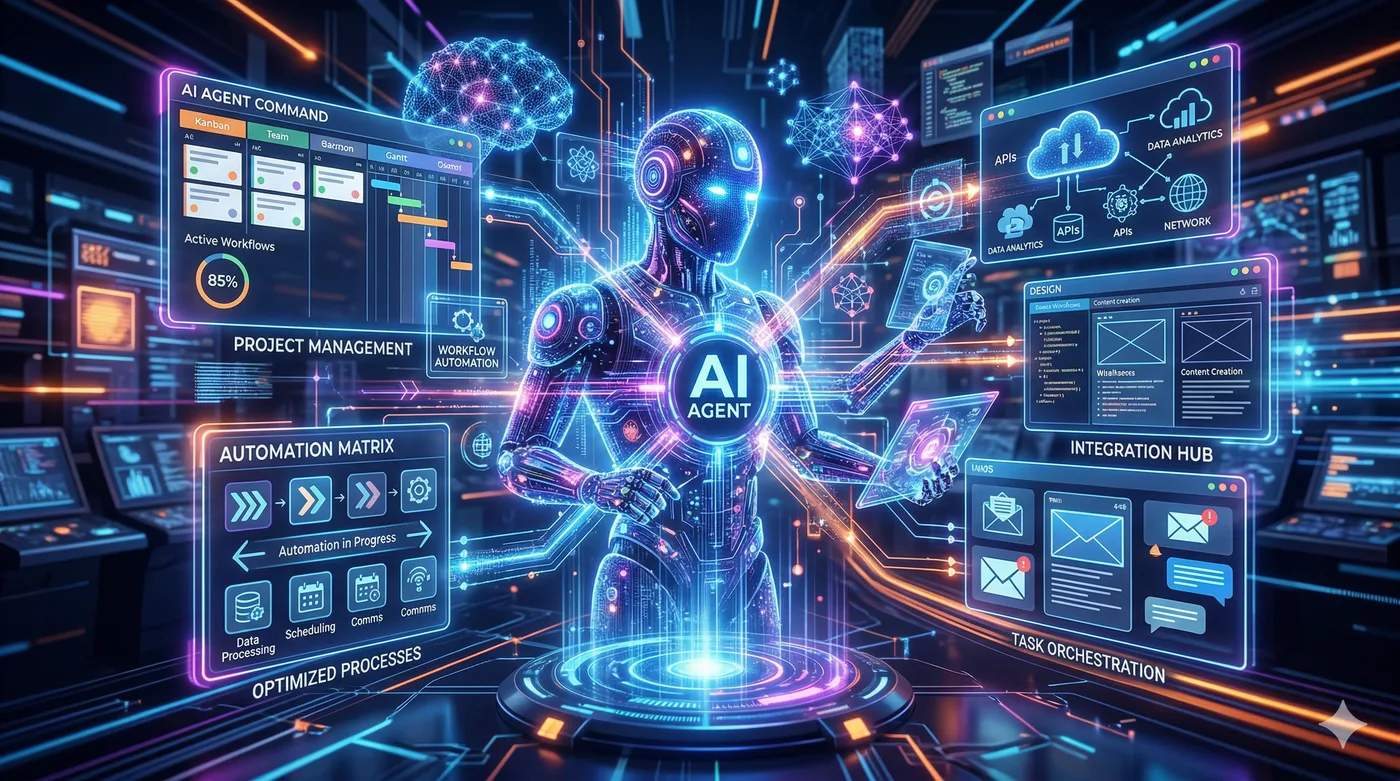
Visual illustration: InfoHelm
What separates an AI agent from a regular chatbot
A classic chatbot usually waits for a user prompt and then returns a response. Its role typically ends at the conversational layer: it explains, summarizes, suggests, or answers questions.
An AI agent goes one step further. It can receive a goal, break it into smaller steps, use external tools, search for information, access internal systems, and decide what to do next based on the results. In other words, it does not remain limited to text alone — it becomes part of an execution workflow.
That does not mean an agent has human consciousness or fully independent reasoning. In practice, its “intelligence” depends on how well the surrounding system is designed: which tools it has access to, what data it is allowed to use, what limitations are in place, and how success is verified.
Why there is so much confusion around AI agents
The biggest reason is that the same term is being used for too many different things. In some cases, an “agent” is really just a well-organized workflow: the system reads a message, identifies the request, calls an API, and prepares a reply. In other cases, the agent is given broader autonomy and can work on a more complex task over a longer period, using several tools and multiple steps.
When both of those approaches are called by the same name, confusion is inevitable. One company uses the word “agent” to describe an advanced automated assistant, while another uses it for a far more autonomous operational system. That is why many demos look impressive at first glance while actually representing very different levels of capability.
From a marketing perspective, that may be useful. From the perspective of readers and potential users, it is not especially clear. A much better way to understand agents is not as some mystical new category of software, but as an architecture: a model plus tools, rules, memory, and execution logic.
Where AI agents actually make sense
Agents deliver the most value when the task is not a one-step interaction and when multiple actions are needed to produce a concrete result. That can include customer support, request handling, internal research, administrative tasks, document workflows, data entry and classification, coding assistance, or connecting multiple business systems.
In those environments, an agent can do what a regular chatbot cannot: it does not stop at an answer, but continues toward execution. Instead of merely explaining a refund policy, for example, an agent can check an order, determine whether the customer qualifies, draft the response, and log the outcome in the system.
That is where the importance of this trend becomes visible. AI models are no longer limited to generating text. Once they are connected to tools and a clearly defined workflow, they can become an active part of software operations.
Where the hype goes too far
Even though the progress is real, the hype around agents often exaggerates how autonomous they really are. Public discussion sometimes makes it sound as if all you need to do is “add an agent” and your automation, support, or productivity problem is solved. In practice, a poorly designed agent quickly turns into a source of errors, bad decisions, and unpredictable behavior.
The issue is not just the model, but the entire system. If an agent does not have reliable tools, access to quality data, clear rules, and a good way to verify results, its autonomy becomes more of a risk than an advantage. The more freedom a system has, the more important supervision, evaluation, and safety constraints become.
That is why the most practical approach is not to begin with grand ideas about “swarms of agents,” but with simple, well-defined tasks. One tightly scoped agent that reliably solves a specific problem is usually far more valuable than a complex system that looks futuristic but frequently gets things wrong.
What AI agents are not
It is just as important to say what agents are not. They are not digital employees in the full sense of the word. They are not a replacement for business logic, they are not automatically reliable, and they are not inherently safe simply because they sound convincing in conversation.
They are still probabilistic systems. That means they can make mistakes, misunderstand goals, draw poor conclusions, or execute the wrong action if they are poorly configured. Serious use of agents therefore does not depend only on a “smart model,” but on the quality of the entire environment in which that model operates.
The best way to think about them is as a new kind of software layer between users, data, and action. Not as an artificial worker that handles everything alone, but as a system that can speed up and simplify specific processes when goals are clearly defined.
Conclusion
AI agents are not magic, but they are not empty marketing either. Their true value lies not in sounding intelligent, but in connecting language understanding with tools, data, and execution.
That is why it is more accurate to say that agents are not a new kind of intelligence, but a new kind of software application built on top of language models. When they are carefully constrained, properly connected, and thoroughly tested, they can be genuinely useful. When they are not, they quickly expose the weaknesses of the systems around them.
In 2026, the most important question is no longer whether AI agents are real, but how useful they truly are in concrete business and everyday scenarios. And as usual in technology, the answer depends far less on hype and far more on implementation.
Note: This article is educational and informational.