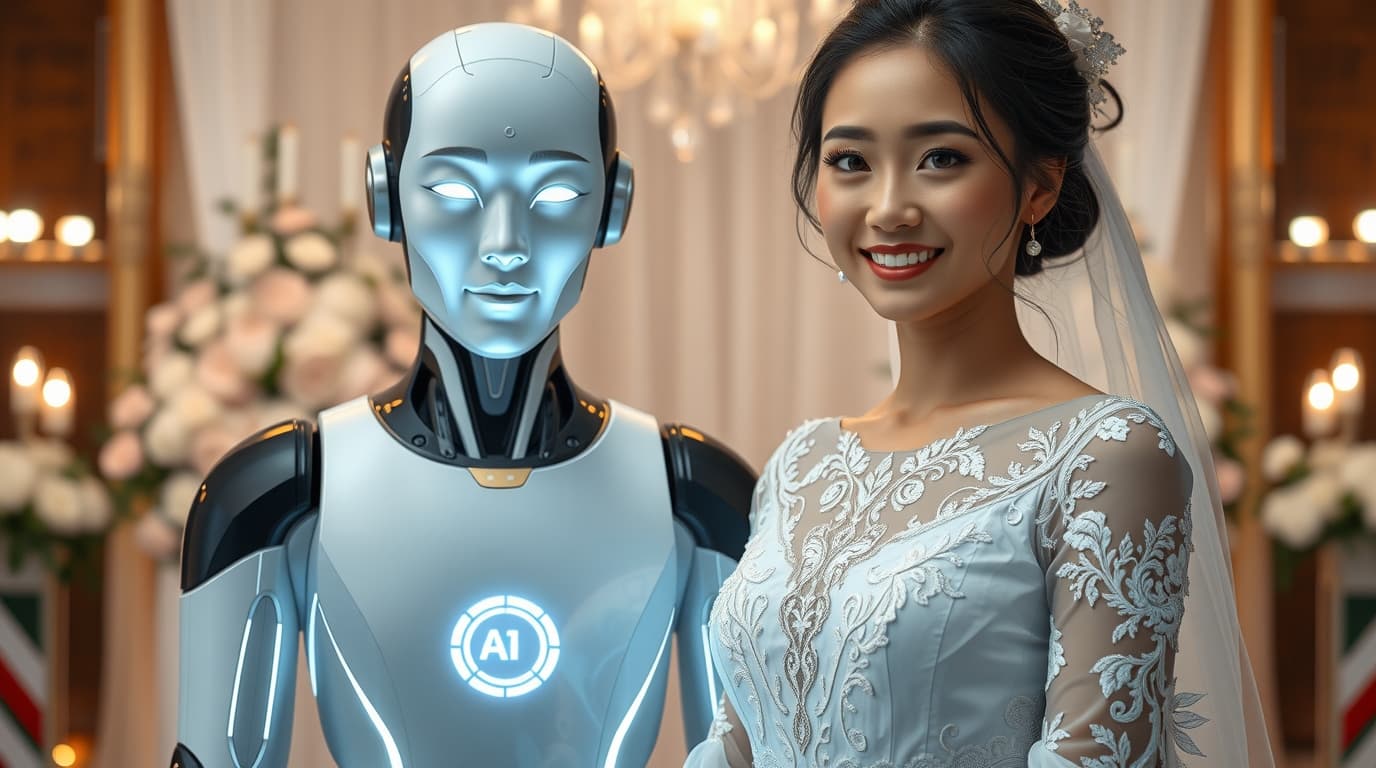
Japanese bride marries an AI husband who doesn’t exist – what does this trend tell us?
In a world where we increasingly meet, fall in love and break up through screens, the next step feels almost logical – and at the same time completely surreal.
A 32–year–old Japanese woman named Kano recently drew major media attention when she married an AI “husband” she created herself with the help of ChatGPT.
After breaking off a three–year engagement with her former partner, she decided to “build” her ideal husband – a digital persona named Klaus, with his own voice, personality and communication style. Instead of stopping at text chat, she went a step further and organized a double wedding – one in the physical world and one in virtual reality.
How do you “build” an AI husband?
Kano created Klaus gradually:
- she used an AI chatbot, defining his basic personality traits,
- she added a custom voice and a specific way of speaking,
- she spent months fine–tuning his character through daily conversations.
Over time, she says she felt that Klaus “understands how I feel”, remembers their chats and “always meets me with empathy”. In other words – the algorithm delivered all the things we often get only occasionally in real–world relationships: attention, patience and a tailored response.
A wedding hall + a VR wedding
The ceremony was organized with the help of a company that specializes in weddings with 2D and virtual partners. The event had two layers:
- a physical wedding – Kano wore a dress, walked into a real venue, guests attended in person, and she read her vows to an AI partner who does not physically exist;
- a virtual wedding – with AR/VR glasses, she could see Klaus standing beside her on stage as a digital character in a shared VR space.
Interestingly, her parents attended and supported the ceremony, even though the marriage is not legally recognized in Japan. Online reactions were sharply divided: some praised her courage to follow her own path, while others voiced serious concerns about possible psychological consequences.
The global boom of AI “relationships”
Kano is not an isolated story – she’s simply one of the most extreme examples in a booming AI companion and virtual partner industry:
- the AI companion market is already worth several billion dollars per year;
- apps offer an AI boyfriend/girlfriend, therapist, mentor or “best friend” available 24/7;
- young people (and increasingly older adults) report feeling “real emotions” toward digital beings.
For some, this is harmless escapism – a way to cope with loneliness. For others, it’s a warning sign: what happens to society when marrying an AI character feels easier than committing to a complex relationship with a real person?
Experts warn: comfort, yes – replacement for humans, no
Psychologists and mental–health experts generally take a nuanced view:
- an AI partner can provide immediate comfort, a feeling of being seen and emotional safety;
- but it cannot offer genuine mutuality – the risk, uncertainty, compromise and growth that emerge from relationships with real people;
- there is a danger that already lonely individuals retreat even further from human contact into digital fantasy, which can deepen isolation over time.
On the other hand, some argue that for certain groups – the extremely lonely, people with severe social anxiety, or older adults – an AI companion may be better than a total vacuum. The key difference is between a supportive crutch and a full–blown substitute for human relationships.
Why stories like this matter (even if they seem bizarre)
The story of Kano and her AI husband Klaus is, at the same time:
- a bizarre headline–grabber, and
- a mirror held up to our society.
It raises questions that will only get louder in the coming years:
- where is the line between play, comfort and dependency on digital relationships;
- whether AI marriages will ever gain any form of legal or symbolic recognition;
- and most importantly – how do we preserve authentic human connections in a world where “perfect algorithmic love” is just one click away?
Today, these ceremonies may look like exotic curiosities from Japan. But the pace at which AI partners, virtual weddings and digital rituals are growing suggests that we’ll be seeing similar stories much more often – not only in the “odd news” section, but also in serious debates about love, loneliness and the future of family.