
Bitcoin – everything you didn't know (and no one told you)
Everyone talks about Bitcoin. Some see it as a ticket to financial freedom, others as the biggest scam in the history of the internet. Many people keep a “small position just in case” – but very few truly understand what they actually bought.
In this article we go through what usually doesn’t get explained: a short history, mysteries and conspiracy theories, how the system really works (without formulas and integrals), plus the real risks and possible future scenarios.

A brief history of Bitcoin (mini timeline)
2008 – the whitepaper and Satoshi
In October 2008 a nine-page PDF appears on a crypto mailing list:
“Bitcoin: A Peer-to-Peer Electronic Cash System”, signed by Satoshi Nakamoto.
No one knows who that is, but the idea is clear: digital money that works without banks and governments.
2009 – the first block
At the beginning of 2009 the genesis block – the first block of the Bitcoin chain – is mined.
Satoshi includes a newspaper headline in it:
“Chancellor on brink of second bailout for banks”
A subtle message: Bitcoin is born at the exact moment when the traditional financial system is being bailed out with money created out of thin air.
First transactions: pizza, forums and the cypherpunk scene
In the beginning Bitcoin circulates among cypherpunk enthusiasts. People send it to each other out of curiosity – more as an experiment than an “investment”.
The legendary episode: in May 2010 programmer Laszlo Hanyecz pays 10,000 BTC for two pizzas.
That was the first “real world” deal. Today those pizzas would be worth hundreds of millions of dollars – but back then it was just a geek experiment.
Early exchanges, Mt. Gox and the first bubbles
As interest grows, the first exchanges appear. The best known early player: Mt. Gox.
No real regulation, no security standards – perfect conditions for:
- the first big bubble,
- the first big crash,
- and the first mass lesson that “price going up” is not the same as real wealth.
Mt. Gox goes bankrupt in 2014 after a huge hack. Many early “bitcoin millionaires” find out that paper wealth is not the same as money in a bank account.
How Bitcoin actually works (without math)
The blockchain as a public ledger
In the shortest possible form: a blockchain is a public ledger of transactions.
- Every transaction is a line in the ledger.
- Many transactions are grouped into a block.
- Every block links to the previous one, forming a chain of blocks – hence the name blockchain.
There is no central bank keeping the ledger. Instead, it’s maintained by a network of computers (nodes) – anyone can verify whether everything “adds up”.
Proof of Work – mining as a lottery powered by electricity
“Miners” are computers that spend electricity to solve a cryptographic puzzle.
The best analogy: a global lottery:
- Every “ticket” is a new attempt to find the correct hash.
- The more tickets (hash attempts) you buy, the higher your chance to win the round.
- Whoever wins gets the right to add the next block to the chain plus a reward in newly created BTC.
Why does that matter? Because this mechanism makes cheating extremely expensive.
To “rewrite the ledger” someone would need more computing power than the rest of the network combined – practically the entire energy budget of a country.
Limited supply – 21 million BTC
Bitcoin has a hard-coded supply limit:
there will never be more than 21,000,000 BTC.
New bitcoins enter circulation through block rewards for miners, but roughly every four years there is a halving – the reward is cut in half.
The consequences:
- every 4 years the “new supply pressure” drops by 50%,
- if demand stays the same or grows, price tends to move up,
- in the community narrative Bitcoin becomes “digital gold” – something scarce that everyone wants.
Mysteries and urban legends around Bitcoin
Who is Satoshi?
The biggest enigma of Bitcoin: who is behind the pseudonym Satoshi Nakamoto?
Theories range from:
- a single brilliant programmer,
- a small group of cryptographers,
- all the way to Satoshi being a government agency or a big corporate team.
The simple truth: we don’t know – and we might never find out.
However, the code is open source and the network today is run by thousands of independent nodes, so the founder’s identity no longer has technical control over the system.
“Bitcoin is a CIA project”, “elite pump & dump”, “alien technology”
As the price skyrockets, the number of legends grows as well:
- “The CIA created Bitcoin to track money.”
- “It’s a tool for the elites to suck money from small investors.”
- “This is technology that aliens gave us.” (yes, this has actually been said).
What survives basic scrutiny?
- Verified: the code is open, every part has been publicly analyzed.
- Internet mythology: most theories are not based on evidence, but on a mix of fear, envy and healthy skepticism.
Bitcoin is less of a “secret project” and more of an experiment that escaped its creators’ control – in both good and bad ways.
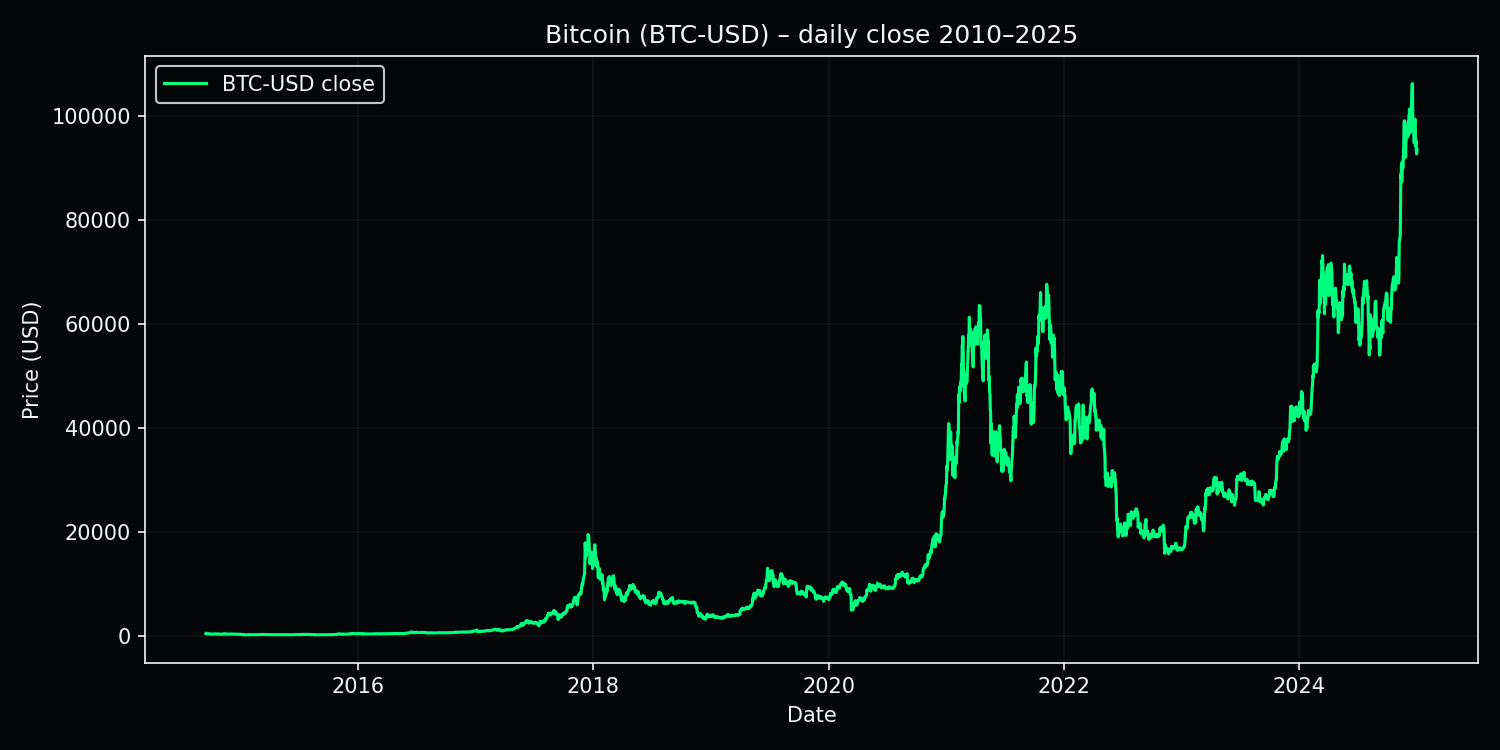
Boom-and-bust cycles
Bitcoin lives in cycles of massive rallies and brutal crashes.
- 2011 – the first big bull run + crash, when the mainstream first hears about “digital money”.
- 2013 – surge from a few dollars to over $1,000, then a crash after the Mt. Gox drama.
- 2017 – ICO mania: everyone launches their own “coin”, Bitcoin races towards $20k, then winter hits.
- 2021 – DeFi, NFTs, institutional entry, ETF talk – and again a correction.
Behind almost every cycle you can find:
- Narrative (a new story why “this time is different”)
- Hype + FOMO
- Over-optimism and leverage
- Reality check
What is Bitcoin today?
Store of value or digital cash?
The original idea in the whitepaper was “peer-to-peer electronic cash” – digital cash.
Today Bitcoin is far more often used as:
- a store of value – something you hold long-term,
- “digital gold” – especially in countries with inflation and unstable currencies.
Day-to-day payments have mostly moved to other layers (the Lightning Network) or to other crypto projects.
Digital gold and ETFs
In recent years:
- institutions, funds and ETFs have entered the space,
- ever more capital is flowing into Bitcoin through traditional channels,
- the narrative is shifting: from “cypherpunk experiment” to a financial asset traded on major exchanges.
That also brings new risks – first and foremost regulatory ones.
Risks: regulation, miner centralization, energy
Some of the key challenges:
- Regulation and bans – from taxes to outright bans in some countries.
- Centralization of mining – if a small number of players control most of the hash power, the ideal of decentralization is weakened.
- Energy debate – the system uses a lot of electricity; some of it is green, some is not. The discussion around this will continue for a long time.
Three future scenarios
1. Bullish – global store of value
In the optimistic version:
- Bitcoin becomes a global digital reserve asset,
- some national treasuries hold part of their reserves in BTC,
- volatility decreases as total market cap grows,
- the “digital gold” narrative becomes a standard part of finance textbooks.
2. Bearish – technological or political strike
In the negative scenario:
- technological weaknesses appear that we don’t see today (cryptographic break, a quantum leap…),
- or there are coordinated bans by major countries and banks,
- capital moves into new forms of digital assets.
Bitcoin remains a historic milestone, but not the key asset of the future.
3. Realistic mix – important, but not “everything”
Most realistically, the truth lies somewhere in between.
- Bitcoin remains the main representative of “hard” digital assets,
- it doesn’t disappear, but it also doesn’t replace all world currencies,
- it co-exists with fiat currencies, stablecoins and other forms of digital money.
Where does $1,000,000 per BTC fit into this?
At the time of writing, Bitcoin trades around ~$100,000 per BTC
(with huge daily swings). To reach $1,000,000 it would need roughly another 10× from here – a lot, but not unheard of in crypto.
How could that look in different scenarios?
Ultra-bull scenario
Bitcoin becomes global “digital gold”, most big funds and some states hold at least a small share of reserves in BTC, and the story of inflation and debt keeps pushing demand up. In this extremely optimistic scenario some analysts see a range of $500,000–$1,000,000 in the next one or two cycles (roughly sometime between 2028 and 2036). This is more of a vision than a forecast.
Realistic mix
Bitcoin stays an important store of value for a slice of investors, but does not become the new world reserve. Institutions enter gradually, regulation gets stricter and growth slows. In that case it’s more realistic to see several “steps” upwards (e.g. 150k, 250k, 400k…) rather than one giant leap straight to a million – and there is no guarantee it will ever reach those levels.
Bearish / “never gets there” scenario
Technological risk, regulation, taxes, bans, better competing solutions – or simply a loss of interest – can break the growth cycle. In that case Bitcoin could stay below previous highs or stagnate for a long time. In this scenario, a million dollars per coin remains just a meme from crypto Twitter.
Bottom line: the numbers sound spectacular, but behind them are only assumptions.
Bitcoin is a mix of technology, economics and human psychology – which means the future is inherently unpredictable.
Conclusion: technology + human psychology
Bitcoin is neither a magic wand nor the scam of the century.
It is a combination of technology, economics and human psychology:
- technology takes care of limited supply and security of records,
- economics reacts to supply, demand and narrative,
- psychology drives the extremes – from “to the moon” to “it will all crash”.
Understanding Bitcoin means understanding all three layers at the same time.
Disclaimer: This article is for information and education only and does not constitute financial, investment or tax advice. Every investment carries risk; you make all decisions solely at your own responsibility.