
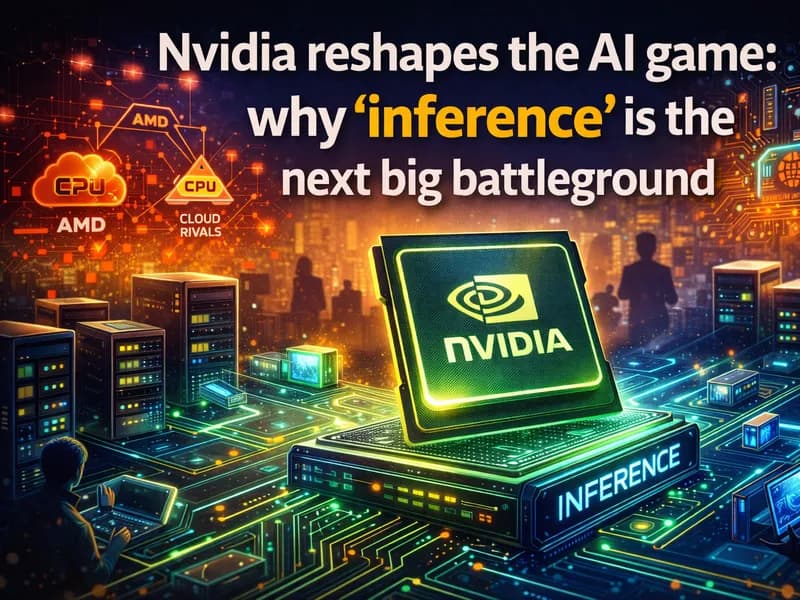
Nvidia Reshapes the AI Game: Why Inference Is the Next Big Battleground
For the past two years, the AI market has largely been framed around one core story: who has the strongest chips for training models, the biggest data centers, and the most powerful foundation models. But as AI moves from research labs into real products, the industry’s focus is starting to shift. It is no longer enough to train a large model once — what now matters is how quickly, cheaply, and reliably that model can respond to millions of users in real time.
That is where inference comes in. It is the stage in which a trained model actually performs a task: answering a question, generating text, summarizing a document, translating, analyzing an image, or running an AI agent. If training was the first major AI race, inference now looks like the next major front.
At GTC 2026, Jensen Huang made it clear that Nvidia wants to dominate that next phase as well. The company is increasingly pushing the idea that the next major wave of AI infrastructure growth will come from inference workloads, not only from model training itself.
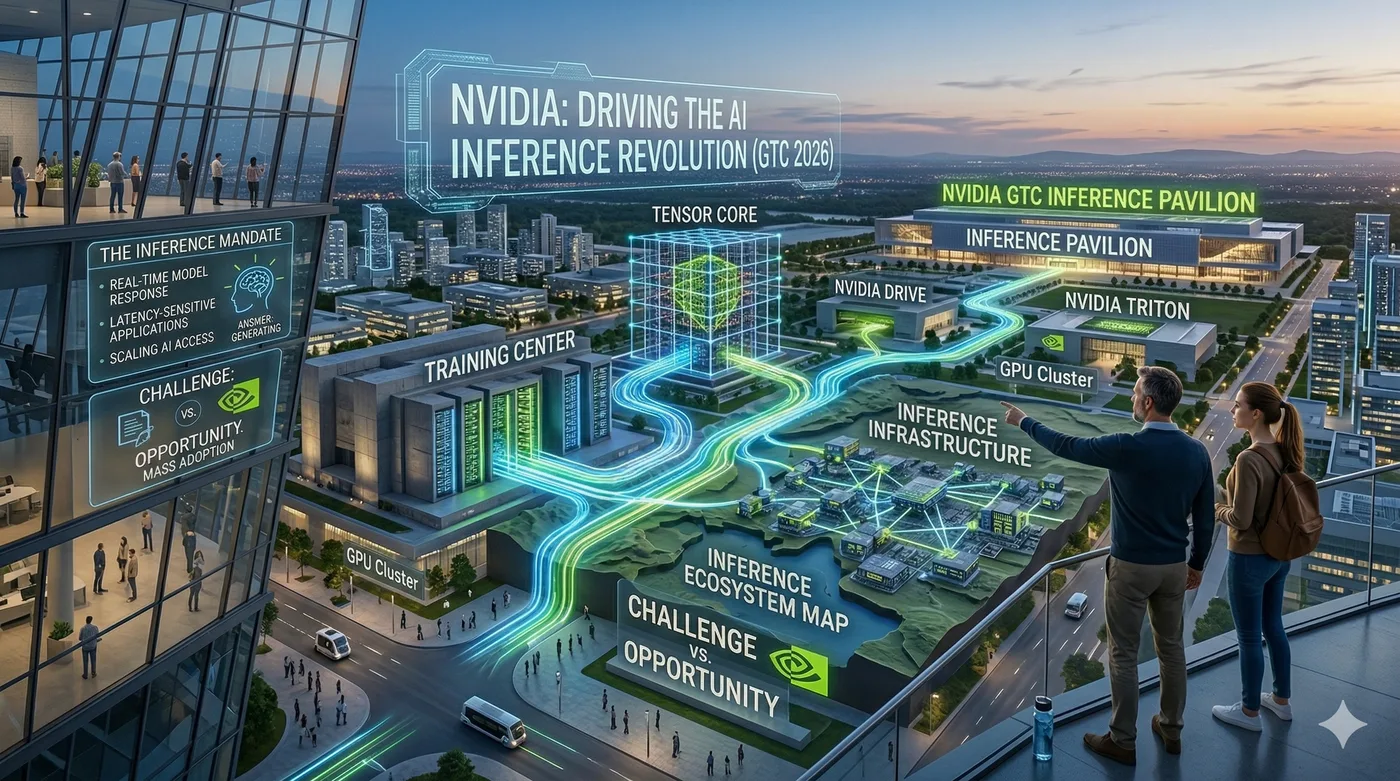
Visual illustration: InfoHelm
What inference actually is and why it matters now
In the simplest terms, training is the phase in which AI learns, while inference is the phase in which AI works. Training is extremely expensive and technically demanding, but inference is what the end user actually sees and experiences. Every time a chatbot responds, an AI tool generates an image, or a system completes an automated task, inference is taking place.
As the number of AI products in daily use grows, the importance of this part of the stack grows with it. It is one thing to train a model once, and another to maintain an infrastructure that can continuously handle a massive number of requests. That is exactly why inference is becoming economically central: it is where the cost, speed, and profitability of AI services are increasingly decided.
Why Nvidia is changing its tone
Until now, Nvidia has benefited most from the explosion in demand for hardware used to train large models. But the market is changing. Big companies are no longer asking only how to build a stronger model, but how to deliver AI to end users at a sustainable cost. That automatically raises the importance of inference efficiency.
That is why Nvidia is increasingly trying to position itself not just as a maker of the most powerful GPUs, but as a supplier of complete AI systems: chips, networking, memory, software, and data center architecture. In other words, the market is moving from raw computing power toward delivery efficiency.
The new war is not only against AMD
The inference race matters not only because AI is entering everyday products, but also because competition in this segment is much broader. Nvidia is not competing only with traditional rivals like AMD. It is also competing with CPU-based approaches, in-house chips from major cloud companies, and specialized accelerators.
That is a fundamental shift. In the training segment, the advantage goes to whoever can deliver enormous amounts of parallel compute. In inference, however, factors such as cost per response, latency, energy efficiency, and the ability to scale across millions of active users become much more important.
That is why this new war is not being fought only at the level of a better chip, but across the entire architecture: networking, memory, server design, software stack, and cloud integration.
Why this matters for the broader AI market
If the previous AI phase was defined by training ever-larger models, the next one may be defined by who can serve those models to users most efficiently. That has major implications not just for Nvidia, but for the entire industry.
For cloud providers, it means a bigger focus on cost per inference request. For startups, it means that having a smart model is no longer enough if it is too expensive to run. For enterprise buyers, it means AI investments will increasingly be judged by operational efficiency, not just by flashy demos. And for users, it means the future winners will be the services that are fast, affordable, and reliable at the same time.
Conclusion
Nvidia is not just changing its marketing language. It is trying to reshape how the market thinks about AI infrastructure. After the era of obsession with training, a new phase is arriving in which what matters most is how well AI performs in the real world — quickly, affordably, and at massive scale.
That is why inference has become the next big battleground. Not because training no longer matters, but because the real commercial value of AI increasingly depends on what happens after training. And Nvidia clearly wants to remain the first choice there as well.
Note: This article is educational and informational.