

How to Build a Home Cinema Without Wasting Money
Many people imagine that a real home cinema requires a lot of money: a huge television, a complicated surround system, a projector, smart lighting, and a pile of extra gear. In practice, however, the biggest difference rarely comes from the most expensive items. It comes from making smart choices about what actually improves the movie experience.
The biggest mistake is spending the budget in the wrong place. People often buy an overpriced screen and then settle for weak sound, or they purchase too many components for a room that cannot realistically take advantage of them. For most living rooms, a simpler and more balanced setup works far better: a good TV, a solid soundbar or 2.1 system, sensible placement, and a little attention to the room itself.
The point of a home cinema is not to chase specs for bragging rights. It is to get the best possible result for your space and your budget. That is exactly where the difference between smart buying and wasted money appears.
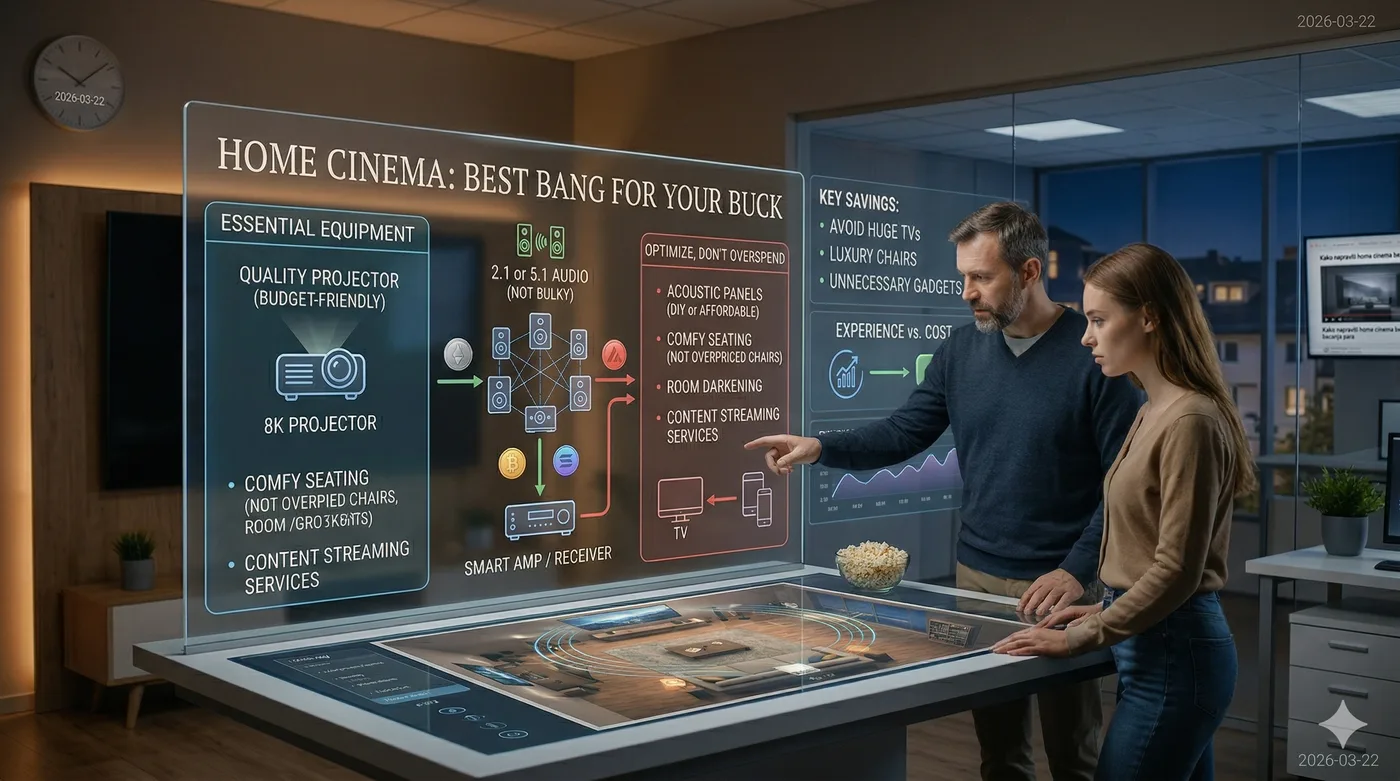
Visual illustration: InfoHelm
First rule: sound matters more than most people think
When people think about a home cinema, they usually focus on screen size first and audio second. That is often the opposite of what delivers the best result. In real living rooms, moving from average TV speakers to a good soundbar or a system with a dedicated subwoofer often creates a stronger cinema feeling than upgrading from one large TV to an even larger one.
If the budget is limited, it is usually more rational to invest in solid audio than to chase luxury visual extras. With movies and series especially, clear dialogue, stronger bass, and a wider soundstage have a much bigger impact on the experience than many people admit.
For most people, a soundbar makes more sense than a full surround system
A full surround system sounds appealing on paper, but in small and medium-sized rooms it often creates more complications than benefits. You need additional speakers, more cables, a better room layout, and extra setup time. That is why a soundbar is the most realistic choice for many people: it takes up less space, is easier to install, and is usually more affordable.
Another important point is that not every soundbar is the same. A model with a separate subwoofer and, ideally, rear satellites will usually create a much better movie experience than the most basic all-in-one solutions, especially in action scenes, atmospheric sound, and low-end impact.
In practical terms, that means a budget home cinema does not have to feel like a cheap compromise. It can simply be a smart format choice that matches the room.
The TV matters, but it does not have to be huge
A big screen is definitely part of the cinema effect, but size alone is not everything. In practice, a medium or large screen with good contrast and solid image quality often makes more sense than the biggest possible size with a weaker panel.
If you watch from a relatively short distance, an oversized TV can become tiring. If you sit too far away, a screen that is too small loses the cinema effect. That is why balance matters more than extremes: a screen that fits the room and the budget, with enough money left for sound and comfort.
This is where many people make their first major saving. Instead of spending nearly the entire budget on a few extra inches, part of that money can go toward a soundbar, blackout curtains, or simply a better overall setup.
Equipment placement is often worth more than a more expensive model
One of the most underrated parts of a home cinema setup is placement. Even good equipment can sound average if it is positioned badly. On the other hand, a solid mid-range setup can sound surprisingly good when it is arranged properly.
Sometimes moving the subwoofer by a meter or lowering the soundbar to a better height does more than upgrading to a more expensive model. The same goes for the television itself: mounting it too high can easily ruin viewing comfort.
Where people most often waste money
The first common mistake is paying for features that sound impressive in a store but matter very little in everyday use. If the room is not suitable for advanced audio effects or the layout is poor, there is not much point in overpaying for premium systems just because of marketing labels.
The second mistake is buying too many components at once. It is much smarter to start with a strong foundation — a TV plus a quality soundbar with a subwoofer — and only later, if it really makes sense, add rear speakers or upgrade specific parts of the system.
The third mistake is ignoring the room itself. A bare room with lots of hard surfaces, poor furniture layout, and a TV mounted too high can ruin the experience even when the equipment is good. Home cinema is not just a list of devices. It is also about how the room works with those devices.
The smartest budget approach
For most people, the most rational home cinema looks like this: a good medium or large TV, a soundbar with a separate subwoofer, proper placement, and as little visual and acoustic clutter in the room as possible. That kind of setup is cleaner, simpler, and much easier to get the best performance out of than a half-finished surround system.
If the budget increases a bit, the next logical step is not exotic accessories, but rear satellites or a better soundbar that handles dialogue, width, and bass more effectively. That is where the biggest improvement in movie immersion usually happens.
Conclusion
Building a good home cinema without wasting money means knowing what truly affects the viewing experience. In most cases, it is not the most expensive model or the longest list of features. It is the balance between picture, sound, room, and placement.
For most homes, the best result comes not from a complicated system, but from a carefully chosen and properly positioned setup. When the budget is allocated intelligently, a home cinema can look and sound serious without the feeling that you paid for a pile of things you do not actually use.
Note: This article is educational and informational.