
Token unlocks: how unlock events affect price and how to track them
In crypto, many people focus first on the chart, market cap, and maybe daily volume. But one of the most important parts of the story is often left aside: how many tokens are still waiting to enter circulation, and at what pace.
That is where token unlocks come in. They do not only show when certain tokens will become available. They can also provide a much clearer view of future supply pressure, possible dilution, and the overall dynamics of a project. That is exactly why an unlock schedule is worth watching together with price action, not only after the market has already reacted.
Of course, that does not mean every unlock automatically pushes price down. But it does mean that future token issuance is a part of the picture that serious observers should not ignore.
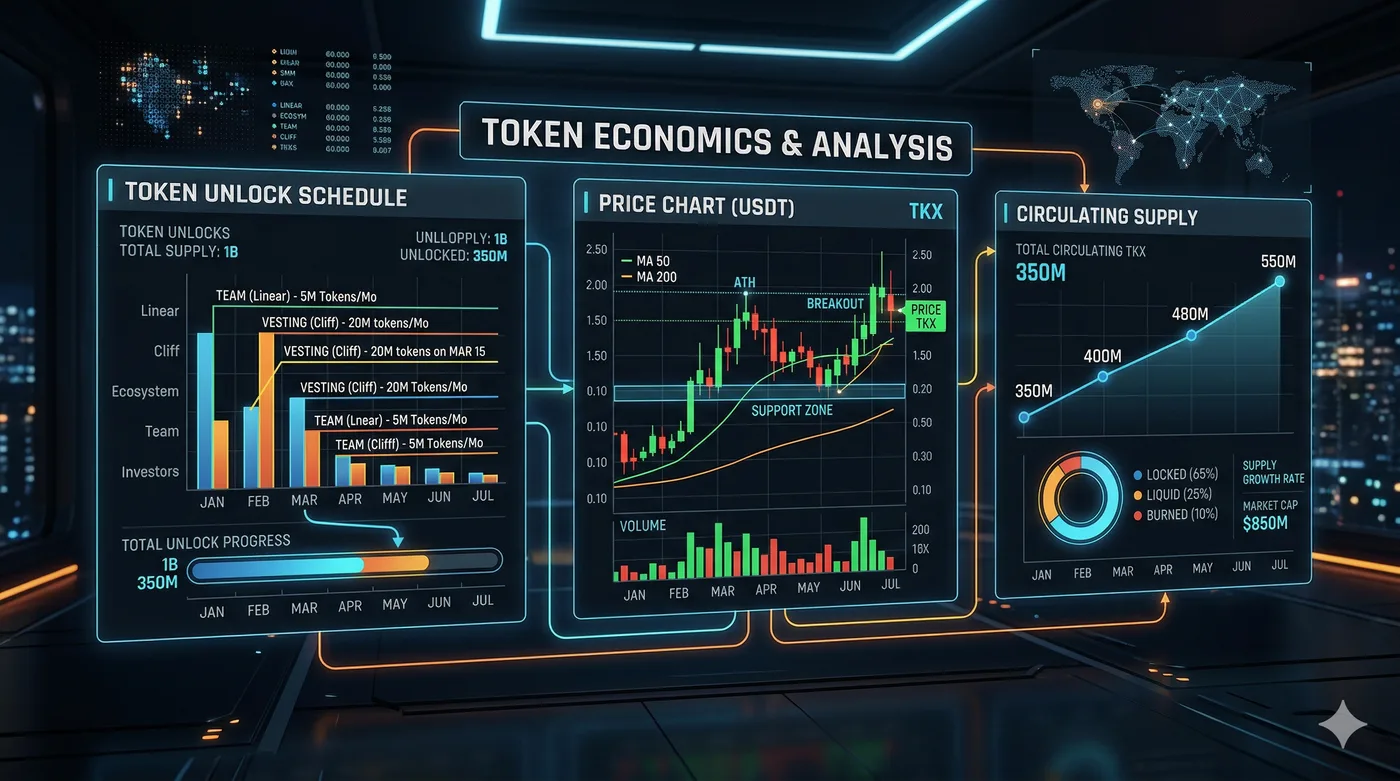
Visual illustration: InfoHelm
What token unlocks are and why they exist
A token unlock marks the moment or period when previously locked tokens become available for transfer, trading, or use. These tokens are usually part of a pre-defined vesting plan and most often belong to the team, early investors, advisors, treasury funds, community programs, or ecosystem allocations.
The reason for locking them is usually simple: projects want to avoid a situation in which a large number of tokens immediately enters the market and creates chaos. Vesting is meant to make distribution more gradual, tie the interests of the team and investors to the project for a longer period, and give the market a more predictable framework.
In other words, an unlock is not an anomaly. It is a built-in part of tokenomics. The problem begins when investors look only at the current circulating supply and ignore how many tokens are still coming.
Cliff and linear unlocks are not the same thing
One of the most important differences is the way tokens are released.
A cliff unlock means that a larger amount of tokens becomes available all at once, usually after a certain waiting period. This is the kind of event the market watches especially closely, because it can create a sudden increase in available supply over a short period of time.
A linear unlock is more gradual. Tokens are released in smaller amounts over a longer time span, giving the market more time to absorb the new supply. That kind of schedule is not necessarily harmless, but it is usually more predictable and less dramatic than a large cliff event.
For investors, this matters a lot. Two projects may look similar at first glance, with comparable market caps and similar narratives, but have completely different unlock profiles. And that profile can strongly influence how the market reacts.
Does an unlock automatically mean price will fall
No. That is one of the most common mistakes in interpretation.
An unlock increases the number of tokens that can enter circulation, but that is not the same thing as immediate selling. Whether actual selling happens depends on many factors: overall market sentiment, liquidity, expectations, the behavior of large holders, project quality, and whether the unlock was already priced in.
Still, it would be just as wrong to say that unlocks do not matter. Higher future supply can create additional pressure, especially when large allocations are going to investors or the team and the market is already showing weakness. In those situations, the unlock may not be the only reason for a decline, but it often becomes an important catalyst.
The healthiest approach is this: do not treat an unlock as an automatic bearish signal, but as a factor that changes the balance between existing demand and future supply.
It is not only about how many tokens are released, but also who receives them
This is the part many people skip.
It is not the same whether the unlocked tokens are allocated to community rewards, treasury reserves, early investors, or the team. The amount matters, but it is just as important to understand who is receiving that supply and what incentive they may have to hold or sell it.
If a large unlock goes to early investors who entered at much lower prices, the market will often view that differently than a release intended for ecosystem programs that are spent gradually over time. In the same way, a treasury allocation is not the same as immediate sell pressure, but it still represents potential future supply that should not be ignored.
That is why serious unlock analysis always includes token allocation structure, not only dates on a calendar.
Why circulating supply is not the full story
One common problem in crypto is that people see the current circulating supply and assume that is the true picture of a project. In reality, that number is only a snapshot in time.
If a large share of the total supply is still locked, then the current market picture may look more favorable than it really is over the longer term. That is why it is useful to watch future issuance, monthly unlock schedules, and the total percentage of tokens that still has to enter circulation.
This becomes especially important in projects that begin with a relatively small circulating supply but a much larger fully diluted valuation. In those cases, the gap between the picture today and the picture later can be very large.
How to track unlocks in time
Fortunately, there are now tools that make this part much easier to monitor.
The most useful approach is to look at several things at once: the calendar of upcoming unlock events, the type of vesting, the size of the unlock relative to circulating supply, the allocation breakdown, and the historical relationship between previous unlocks and price behavior.
In practice, people most often use specialized token unlock trackers and tokenomics platforms that show future emissions, allocation schedules, and projected changes in supply over time. That is far more useful than relying only on a single number from a market website or a few short posts on social media.
In other words, if you follow a token, it is worth following its unlock calendar just as carefully as you follow the chart.
How to read an unlock without panic and without naivety
The worst possible reaction is to see an unlock and conclude either “this is definitely going to crash” or “this means nothing.”
A smarter approach is to ask a few simple questions. How large is the unlock relative to current circulation? Is it coming all at once or gradually? Who is receiving it? Has the market been talking about the event for weeks already? Does the project have enough liquidity and demand to absorb the new supply?
When viewed this way, an unlock stops being a mysterious threat and becomes part of normal risk analysis. It does not guarantee a perfect price forecast, but it greatly reduces the chance of being surprised by something that was actually public information all along.
Conclusion
Token unlocks are one of the most important parts of crypto economics that beginners often overlook. They do not determine price by themselves, but they strongly influence the framework within which price is formed.
That is why it is not enough to look only at the chart, the current market cap, or the project narrative. It is worth watching future supply, the vesting schedule, and the structure of token allocation. Only then does the picture become much more realistic.
In a market where so much revolves around narratives and short-term excitement, the unlock calendar is one of the few parts of the story that brings the focus back to numbers. And in crypto, that is often the difference between a superficial impression and a more serious understanding.
Note: This article is informational and does not constitute financial, investment, or legal advice.