Staking: What It Is, How You Earn, and the Real Risks
Staking is one of the most discussed topics in the crypto economy because it seems to offer something many investors find ideal: hold tokens and earn additional yield at the same time. In practice, however, staking is not the same as “free money,” and it is not the same as simply holding crypto in your own wallet.
At its core, staking is how certain proof-of-stake networks use locked tokens as the economic foundation for security and transaction validation. Participants who stake their assets may receive rewards from the network, but they also accept a set of constraints and risks. In some models you delegate to a validator, in others you use an exchange or staking provider, and in others you receive a liquid token that represents your staked position.
That is why staking should never be judged by APY alone. Lock-up terms, exit timing, provider fees, slashing exposure, technical and custody risk, and the volatility of the token itself all matter just as much.

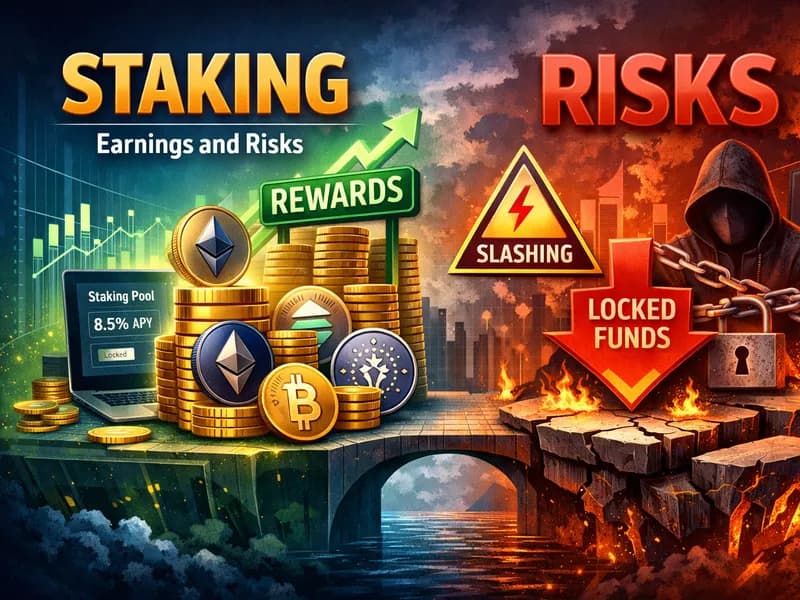
Visual illustration: InfoHelm
What staking is and where the yield comes from
In proof-of-stake networks, validators lock capital or receive delegated capital in order to participate in network consensus. In return for performing that role correctly, they earn rewards, which are then shared with delegators or users of staking services.
That means staking yield is not a fixed interest rate in the traditional banking sense. Rewards change over time depending on network rules, on-chain activity, the number of validators, and the reward distribution model. Even when headline yield appears stable, the actual outcome for the user depends on several factors: provider commissions, payout timing, possible penalties, and the market price of the underlying token.
In other words, staking is primarily a mechanism of network economics, not a savings account with a predefined return. That is a crucial distinction that many beginners overlook.
Where people most often misjudge staking
The most common mistake is focusing only on the percentage yield. If a token offers a high APY, that does not automatically make it the better opportunity. The first question should be: where does that yield come from, and what risk comes with it?
Even when a validator performs correctly, staked assets may be less liquid than many users expect. On some networks there is an unbonding period, while with certain providers you are also dependent on their operational rules and withdrawal processes.
That is why higher yield often comes with lower liquidity. And in crypto, liquidity can sometimes matter more than APY itself.
Lock-up, unbonding, and the problem of timing
One of the main economic risks of staking is not necessarily direct token loss, but the loss of flexibility. When you stake assets, you are effectively agreeing that they may not be freely movable at any moment.
This matters especially in a volatile market. If the token price drops sharply while your assets are in a lock-up or unbonding period, you may not be able to react in time.
That is why staking should be viewed as exchanging part of your liquidity for potential yield. It is an economic trade-off: you gain rewards, but give up some flexibility and exit speed.
Slashing: uncommon, but real
Slashing is the mechanism by which validators are penalized for breaking protocol rules. In theory, it is one of the core reasons proof-of-stake networks can remain secure: validators have direct financial exposure, so misbehavior or serious errors can lead to losing part of the capital involved.
But it is important to understand that slashing is not identical across all networks. The rules, penalty size, and practical conditions vary from chain to chain.
That means staking rules are not universal. You need to evaluate risk on a network-by-network basis, not based on the abstract idea of staking. On some networks, the bigger issue may be slashing; on others, poor validator performance; and on others, custody or smart-contract risk.
Provider risk: staking is not only about network risk
When a user stakes through an exchange or centralized service, they are not taking only blockchain risk. They are also taking provider risk. That includes operational risk, fee structure, terms of service, reward accounting, and the provider’s own handling of issues when something goes wrong.
This is where the difference between self-custody and provider-based staking becomes important. When you use a provider, you are not just outsourcing the technical work, but also part of the trust model. That may be acceptable to some users because it is simpler, but economically it means shifting part of the risk onto an intermediary, at the cost of fees and additional third-party dependence.
Liquid staking: more flexibility, but another layer of risk
Liquid staking has become popular because it solves part of the lock-up problem. Instead of your assets becoming entirely unusable while staked, you receive a tokenized representation of your staked position that can be used elsewhere in DeFi.
However, liquid staking does not remove risk. It changes its form. Instead of a pure lock-up problem, you now add smart-contract risk, secondary market risk, and broader protocol risk. If you use that derivative as collateral or combine it with other strategies, you are no longer evaluating staking yield alone, but the risk of the full structure built around it.
That is why liquid staking tends to suit users who understand that more flexibility often also means more interconnected points of failure.
How to think about staking yield realistically
The healthiest approach is not to treat staking as passive income isolated from the rest of the market. Real return depends on three levels at once: the network’s own economics, the terms of the staking model, and the market price of the token.
You may earn additional tokens while your total position still falls in value if the asset price drops significantly. You may have a strong nominal APY but lose flexibility when you need it most. You may use a reputable provider and still remain exposed to protocol rules and market volatility.
That is why staking makes the most sense for users who already want to hold a specific proof-of-stake asset over a longer period and are willing to trade some liquidity for additional yield. For users who want fast capital rotation or maximum exit control, staking is often not the ideal tool.
Conclusion
Staking can be a useful way to generate additional yield in the crypto economy, but only if you understand what is actually being exchanged. You are not receiving “free interest.” You are accepting a set of conditions: locked capital, variable returns, validator risk, possible slashing, provider fees, and dependence on infrastructure you do not directly control.
That is why the real question is less “what is the APY?” and more “what am I taking on in exchange for that APY?” Once framed that way, staking becomes easier to assess realistically, as a tool with upside, but also with very concrete risks.
Note: This article is informational and does not constitute financial, investment, or legal advice.